Long Time Listener, First Time Caller

Isn’t that what they say in those call-in radio shows? Well, long-time dot watcher and first-time contributor here! If you’re a fellow dot watcher you’ve probably settled into a daily pattern that’s become more sustainable after the constant dot watching (refresh, refresh, refresh) of the first couple days. Course speeds now average around 2 miles an hour in the 350 distance as most of the bikers have made it to McGrath and skiers and walkers continue their journey. Life for our racers has taken on a similar sustainability as life on the trail settles into a routine.

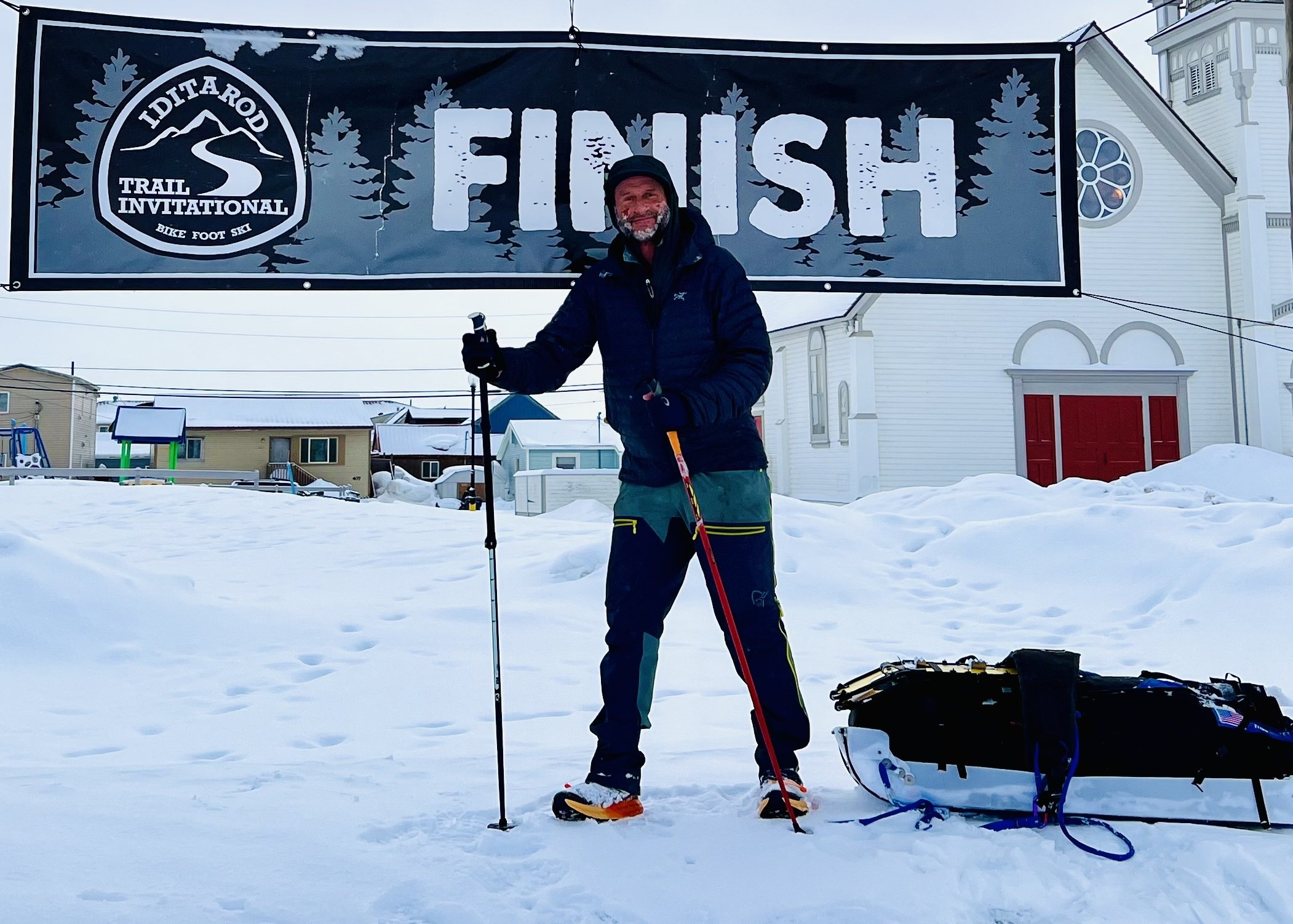
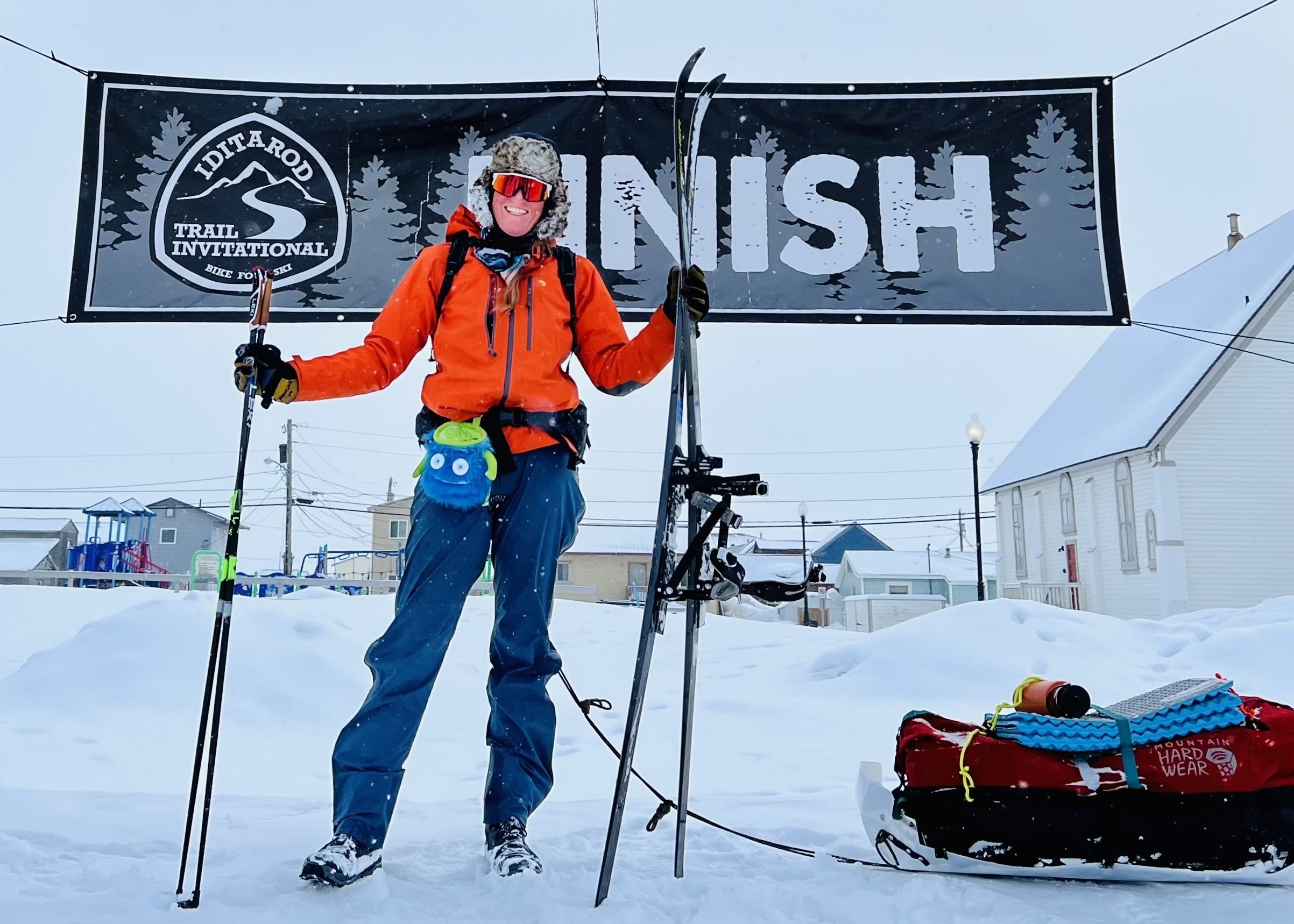
Scott Hoberg, our first foot finisher, made it to McGrath just after 8pm yesterday (February 28). Scott was also the first person to take the overland route to McGrath (the orange route on Trackleaders) as opposed to the river. After having made it within 25 miles of McGrath in 2018, not sure if it was unfinished business or good intel that led to his choice. Tracie Curry, on skis, made a similar choice and is not only the 350-mile women’s ski winner but the new 350-mile women’s ski record holder with an unofficial time of 5 days, 22 hours, 4 minutes, knocking a full day off the previous record of 6 days, 23 hours, and 13 minutes held by Robin Beebee and Christy Marvin.

This was not predicted to be a great year for skiing given the lack of snow along parts of the course. Hopefully Leah can get an interview with one of the three women skiers in this year’s 350-mile race for the WWW YouTube channel. Jessie Gladish, the next female skier, just left Nikolai and is poised to become the second woman to complete the 350-mile race in all three disciplines, having completed it on foot in 2018 and on bike in 2024. She has also completed the Yukon Arctic Ultra in all three disciplines. Our final skier, Petra Francke, is 40 miles outside of Nikolai, completing this year’s race as a 10th Anniversary trip with her husband Jan!

For our bikers, Beth Freymiller, Amanda Harvey, Lynn Hall, and Colleen Kersgard made it to McGrath, almost closing out the field on our women’s bike division. Two women bikers, Janice Tower and Julie Perilla Garcia have left McGrath on the next stage of their journey to Nome. The Iditarod sled dog race starts tomorrow in Fairbanks and will join the ITI race route in Ruby.

Kari Gibbons and Magdalena Paschke, both in the 1000-mile race, continue the push from Rohn to Nikolai. While many of us were sleeping, the three 350-mile female foot racers made it into Rohn well under the 2pm cut off this afternoon. If you’re a family or friend dot-watcher, you’ve probably asked what on earth made them decide to do a race this long? Perhaps you’re a previous racer who’s been asked this question. For most, the choice isn’t an immediate one. There were likely early warning signs such as a marathon, an ultra race, and another ultra race. Each new goal, once faced and overcome, leads to the next and one day they find themselves signing up for a 350-mile race, in the middle of winter, in Alaska.

These goals though, aren’t always met with immediate success. Each of our three female 350-mile racers has tackled this race before and come up short. So we are excited to watch them tackle this difficult race again. Getting to Rohn was always going to be a mental challenge for Melanie Vriesman and Stacy Fisk, after being thwarted by weather and difficult conditions over Rainy Pass in 2024. Sarah Hurkett is still resting in Rohn and has an interesting push-sled set-up that, after seeing it at the start, I want to know more about (and am hoping it performs well in the tussocks)! Speaking of which, the fu$%ing tussocks are not going to make the trek out of Rohn easy, but we know they are tough and determined women!

A Day in the Life

Day 6 of the Iditarod Trail Invitational

Ever wondered what checkpoints are like? Prepare yourself for an update from Checkpoint Nikolai! Just a few days into racers arriving here at route mile 259.3, a daily pattern has emerged. In the early morning hours, one or two at a time, athletes emerge from their naps and slowly put themselves together. There’s coffee to make, oatmeal to consume, gallons of water to decant into thermoses, hydration bladders, water bottles, and of course people. Feet are cared for, faces and smiles get a smear of skin protectant, gear is organized (and re-organized, and tweaked again). Racers get rid of a few extra trail snacks, or perhaps snag something that was left behind. By daybreak most have set off on their final 50-60 miles to McGrath.

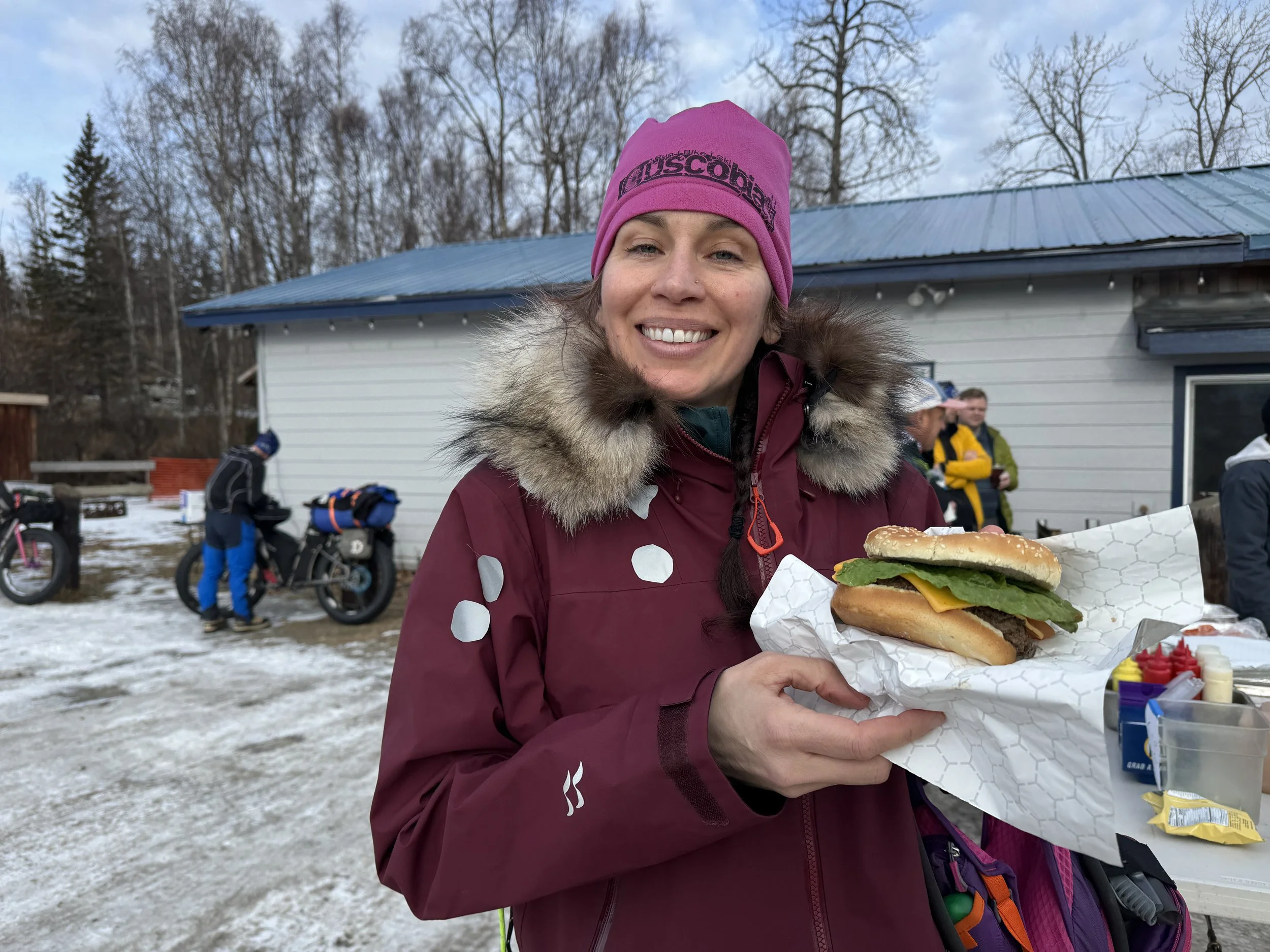
Days tend to be quiet. During the afternoon, exhausted after their battle with tussocks, athletes start to trickle in. Hot Tang or hot chocolate are offered, and they make a choice between salmon, beef or veggie burgers. Cold layers are peeled off, clothes are hung, and dazed athletes eat and drink and start to come back to themselves. Racers chat about tussocks, where they slept the night before, and when they’ll continue on to McGrath. They ask for information such as directions out of town, overland or river route, trail conditions, or the weather forecast. After eating what they can (GI distress is a real thing), they crash out on a mattress or cot if one is available (we have three mattresses and two cots, luxury!), or on their sleeping pad. By late evening clothes are hung everywhere, the floor is crowded with people napping and floor space is at a premium, the lights are dimmed, and those awake chat quietly.

We volunteers fetch water from the clinic (the water at our location is not potable), make sure there’s plenty of hot water available, tidy up behind athletes scrambling out the door, and try to make sure they are drinking and eating. The volunteers here are amazing. One example, we walked over to the dump, retrieved a rusted out saddle from an old bike, and fixed it up as a possible replacement for broken saddle rails. Jay Cable is a master of building rapport with the local community, speaking to kids at the school, coordinating to take students out for a ski, and always game for chatting with locals.

Back to the trail. We’re going to digress from our usual WWW programming to talk about Tucker Costain. First place skier Tucker Costain finished at 6:56am this morning, joining Jim Jager and Chet Fehrman as just the third person to ski to McGrath in under five days. Every racer has a reason to get to the finish line, some rush, some not. Tucker had a unique reason to be in a hurry, his partner is starting the Iditarod sled dog race in Fairbanks on March 3.

Had the Iditarod used its normal route from Anchorage, he would have been in McGrath when she came through; an ideal scenario. Thanks to extremely low snow (basically none) in sections of the course, the route was changed at the last minute and the new course doesn’t run through McGrath. This left Tucker in a bind, how could he get to Fairbanks in time when there are limited flight options out of McGrath? He had to make the last scheduled flight out of McGrath at 3:00pm on Friday. He did that handily, despite breaking a pole before getting to the first checkpoint, refusing a replacement pole and instead skiing with a DIY pole made out of a small tree trunk (really, check out the photos).

Nome racers Janice Tower and the always cheerful Julie Perilla Garcia left Nikolai this morning in good spirits. The difference between 1,000 and 350 racers is becoming more and more apparent. Julie and Janice rolled in with good spirits after the tussocks, noting that a similar section of trail was much worse in 2022, and that you always know the trail will throw something difficult at you. Magdalena Paschke and Kari Ann Gibbons are deep into the Farewell Burn, about to hit those tussocks. With the larger sleds Nome-bound athletes often have, this section of trail will be challenging.

350 racer Henriette Geel finished early this morning, the first of several racers that went through the 2024 ITI winter training camp. Kendall Park finished late this morning, and Gillian Smith and New Zealand racer Nina Stupples this afternoon. Beth Freymiller is resting in Nikolai. Foot athletes Stacy Fisk and Melanie Vriesman are making their way over the pass on what looks like a snowy day with light winds. Sarah Hurkett rested at Puntilla Lake(Rainy Pass Lodge) for more than16 hours, but is now on the move and headed for Rohn.

Leader for the ladies ski field, Tracie Curry, is closing in on Nikolai. If she doesn't vary her pace too much she should arrive in Nikolai late tonight. Jessie Gladish is through Farewell Burn and working her way toward Bear Creek cabin, and Petra Franke is just a few miles from Rohn.

In Nikolai, the forecast calls for a 20% chance of snow tomorrow and rising temperatures. The area between Salmon River (where the route from Rohn to Nikolai makes a 90 degree turn to the north) is known for cold February winds, and indeed there’s been a continuous breeze since we’ve been in Nikolai.

Wild Winter WomenComment
It's the Little Things

Day 5 of the Iditarod Trail Invitational

One of the best things about the ITI is that there is enough suffering to go around and no one is immune from it.  For some, it may be simple exhaustion, for others blistered feet, and even others a gastrointestinal system that is in such distress you can’t imagine eating anything despite a 70+ mile slog before you. (Always bring Tums in your first aid kit!)  And for nearly everybody on this year’s trail, the 20+ miles of “fu$%ing tussocks” was the great equalizer of suffering.  Some who would’ve pushed the pace to pass an athlete who was seemingly within reach gave up after the demoralizing tussocks.  Those on foot or skis (who were honestly just foot people at this point) may have had to suffer longer than their counterparts on bikes, but still…there was that fantastic and humbling experience of pain and misery.  And why is it that pain, suffering, and misery is such a gift? It’s because, for example, when you get to a place like McGrath and someone offers you your first cup of French pressed coffee in three, four, or even ten days, it is the best thing you have ever tasted. There is a renewed appreciation for the little things.

With that in mind, let’s celebrate some of our Wild Winter Women sufferers. Yesterday, we anticipated Carol Seppilu’s win in the ITI 150 and it in fact happened.  Carol became the Women’s Foot Champion for the ITI 150 at approximately 10:27pm on February 26th.  Carla Gabrielson joined her in second place at the finish line (though honestly Carol was probably asleep) at approximately 4:43am on February 27th.  I hope the cute fox who I’ve heard is serving on the welcoming committee at Puntilla/Rainy Pass Lodge was there to cheer both these strong, Wild Winter Women over the finish line. Congratulations, ladies!

The track leaders map is this wonderfully, colorful Conga line of athletes from Puntilla to somewhere past Ophir.  (Go Troy and Peter!)  The tail of our Conga line (let’s call them our party people, as in business in the front, party in the back…subtle, I know) consists of some of the best of the best. Jan and Petra Francke are still fully enjoying their anniversary tour of the trail. (They don’t get to avoid suffering just because it’s their anniversary. They are on skis after all.  And there’s the “fu$%ing tussocks” in their future.)  Sarah Hurkett, Melanie Vriesman, and Stacy Fisk (our last three Alaskan women foot athletes on the trail) are taking a little break as well, enjoying the amenities of Rainy Pass Lodge (an outhouse and electricity…it’s the little things). Sean Brown is also in the party people house.  He’s on his way to Nome along with two guys who really bring the capital “P” party to the foot division, Klaus Schweinberger and Donald Kane. I’ve spent many miles on the trail with these two gentlemen and two finer individuals you will not find. They are good for a beer, gummy bears, and, in a quick pinch, fixing your broken trekking pole with the metal wind protector from your camp stove (hypothetically speaking, of course). Our party people are doing just fine with time. They have until Friday, February 28, at 2pm to depart from Rainy Pass and must leave Rohn by 2pm on Saturday, March 1. That will be the sixth day of our sufferfest and you have a total of ten painful days in which to enjoy the trail to McGrath.

Now back to the heart of our Conga line, and focusing on our Wild Winter Women (I wish I could talk about everybody. I’m sorry! Suffering isn’t limited to the trail), stretching between Puntilla and Nikolai.  Alexandria Manley, our final female 350 biker, is descending through Dalzell Gorge as I write and on her way to delicious brats (both veggie and meat…just two, no more…pile on that suffering) and hot tang ( the little things…nothing tastes quite as good as hot tang in Rohn).  About four miles ahead of Alexandria and only four miles outside of Rohn, is our own WWW Kari Gibbons.  We’ve heard from Jessie Gladish that skiing over the pass was great.  I hope the foot division has a similar perspective.  Kari will soon join Magda Paschke, female 1000-mile foot division, who has been resting for the last 40 minutes.  Currently, there are five athletes in Rohn, snuggling up in their sleeping bags on the spruce bows…and that’s just about capacity for that wall tent.  As folks start trickling in from the pass, those who are trying to get just a little shut-eye before the tussock hellscape will be gently (and then not-so-gently) prodded to move along and make some space. It’s time for the suffering to begin.

And, we’ve heard, that it doesn’t take long once you leave that lovely wall tent to start experiencing your first moments of fear and anxiety…suffering even.  You may have noticed, for example, Beth Freymiller on bike leaving Rohn, her dot seemingly wandering around, staying way too long on the Kuskokwim River, most likely then trying to bushwhack over to get on the right trail, and in the end just circling back to Rohn for a “take 2.”  That’s because there is no real trail right now.  Imagine a sheet of bare ice, possibly a scratch mark here or there, but nothing solid to point you in the right direction. And the only real guidance you get is “get off the Tatina as fast as you can.”  (I mean there’s always GPS but GPS doesn’t tell you where the open water is and the best path forward.)  So, before you hit the “fu$%ing tussocks” you get the ice and water and indecision.  I’d like to say that makes the tussocks a little less painful but that doesn’t seem to be the case.

One good thing about the tussocks (aside from a greater appreciation for all things), is that they are serving to give our dedicated volunteers in Nikolai some breathing room.  They seem to be spreading that Conga line out, nice and even, so that Amber can continue to make burgers but also sneak in a shower every other day or two. Colleen Kersgard on bike has a little while before she gets to experience cleanliness and a meal cooked on a stove again. She’s about 43 miles out. Tracie Currie, on skis, is about a mile and a half in front of her, moving very slowly (1.4mph…maybe she’s eating, perhaps sleep walking, but most likely it’s the tussocks) for a woman who just the day before was able to ski up and over the pass.  Beth Freymiller, Amanda Harvey, and Lynn Hall, all on bikes, are taking a well-deserved break on the side of the trail about 37 miles outside of Nikolai.  Never fear that Amber Crawford has nothing to do at the Nikolai checkpoint, Nina Stupples is about seven miles out and should arrive in the next hours.  And while Amber awaits her arrival, she has a full house of Wild Winter Women (Julie Perilla Garcia, Janice Tower, Kendall Park, Gillian Smith, and I’m guessing Henriette Geel…because she’s only .9 miles from Nikolai and she’s been there for 5 hours) and men. PSA: trackers are fallible devices.  For instance, Scott Hoberg is not where his tracker says he is.  We have reports that he’s on the trail and moving. We are guessing that he will stop before Nikolai because that’s a long stretch between where he stopped for a bit last night and the checkpoint (more suffering for family, friends, and casual dot watchers alike).

Let’s get to the business end of this Conga line of suffering.  Erin Mingrone left Nikolai around 8:15 am this morning for the final push along the river into McGrath.  She was tired and slept a full night (the little things!) and left in great spirits. She, we believe, is the first finisher from the 2024 ITI Winter Training Camp, rolling into McGrath at 4:35pm this afternoon. Congratulations, Erin!! A note about the river route, it follows the Iron Dog route the entire way and is longer than the overland route. It’s about 58 miles.  And while it might be longer, racers are reporting that the trail is in great condition. What a relief after (can you guess?) the “fu$%ing tussocks”! We expect the foot racers to take the overland route (it’s shorter…don’t add the miles at the end…at some point you get diminishing returns for all that suffering), but we have no information yet about conditions.

One last shout out and congratulations to our wonderful, Brazilian, Wild Winter Woman, Mayella Krause, who finished her second ITI 350 (first was last year!) at approximately 12:49pm this afternoon.  Because of her posts, I am now transitioning to calling the “fu$%ing tussocks,” “Chewbacca heads” and smiling every time. It is indeed the little things. Enjoy your finish and your rest, Mayella! Plus, I heard a rumor that there will be mancakes in the morning!! That’s not actually a little thing but definitely something to celebrate. Party on!


Wild Winter WomenComment
Celebrations and "F-ing Tussocks"

Day 4 of the Iditarod Trail Invitational

What a fantastic day! Day 4 brought us thrills and chills (it is a winter ultra in Alaska after all) plus our first two Wild Winter Women (WWW) finishers. (Warning this post is all about our women athletes.)

Lael Wilcox is a phenomenon unto herself. Her list of biking accomplishments is long. Just look at her Wikipedia page. And on top of that, according to this lovely woman who I chatted with near Big Lake while waiting for the bikers to pass by on day one, she is also especially humble and kind.  She is this year’s Women’s Bike Champion for the second year in a row, coming in with the third fastest time in race history. She did her home state proud.  We love our local Alaskan, bad-a$$ women.

In second place with an equally impressive time (the sixth fastest to McGrath) and list of accomplishments to her name is Minnesotan, Kate Coward.  According to our very own WWW Leah Gruhn, what is most impressive about Kate is that she digs deep. And she dug deep this year much like she did in 2020.  Reports from the trail suggest that she experienced something very similar to what she experienced in 2020, blurring of vision and inability to just see what was around her.  Luckily, she has a great sense of direction and intuition and gutted it out to a second place finish.  BTW, when she was experiencing all that blurry vision in 2020, she also just happened to win the women’s bike race.

Every year this race is different depending on snow conditions, temperatures (cold to very freaking cold), rampaging moose, and whatever else Alaska can throw at you.  But there are a few “good” (in quotes because they’re not good for everyone [foreshadowing alert]) years where the bikers get to push their limits.  And this was one of those years.  Both Lael and Kate join an exclusive group of women who were lucky enough to get low snow years and make it to McGrath in less than three days.  The women who came before them were Heather Best in 2014 who owns the current women’s bike course record and Tracey Petervary in 2015. I want to honor not just Lael and Kate but also Heather and Tracey. My hats off to these incredibly strong, dedicated, and powerful women!

While Lael and Kate are hopefully resting their legs and planning their next meals, the race continues for many.  Athletes are trickling through Nikolai at a slow but steady pace. (Kara Oney just left and, according to our own WWW Amber Crawford who is volunteering at Nikolai, she is looking good! And she will be our third WWW bike finisher sometime late tonight or early Thursday morning. Knock on wood!)  Many are coming in exhausted, and with plenty to say about tussocks. (As an aside, my partner finished his first ITI today [allow me a momentary cheers to Mike Monterusso - congratulations, babe!], and the first words he texted me from McGrath were “fu$%ing tussocks.”) 

You may wonder what could cause such consternation. What In fact is a tussock? Well, they are ball-shaped clumps of sedges formed by Eriophorum, also called cottongrass. If you will, imagine top-heavy mushrooms that threaten your center of gravity to such a degree that no amount of balance can stabilize you atop their crests.  Add to this that some are thigh high so trying to push a bike or pull a sled could drive one slightly mad.  So, you can perhaps empathize with athletes who are going through dozens of miles of “fu$%ing tussocks.”

Beyond the tussocks, and focusing on the positive, some racers enjoyed a wondrous display of northern lights while traveling along what has been described as an ice highway with plenty of bison poop and bison holes. (Doesn’t that sound just lovely?) And that’s what the rest of the field can expect.  Luckily for the skiers, there’s no snow, so they won’t be skiing through that bison poop. The skis will stay clean. (I really hope all of our skiing athletes either have really comfortable ski boots or brought their running shoes (join the foot people, we’re a friendly bunch!). Unluckily for anyone pulling a sled, however, expect some destruction. I hope repair kits, gorilla tape, and a healthy vocabulary of swear words were all part of the race preparation.  It is a long journey for anyone from Rohn to Nikolai and for those on foot, or carrying skis, (remember what I said about foreshadowing) it can take three days of trudging along and cursing those “fu$%ing tussocks” and maybe the bison poop too. 

Speaking of skiers, Tracie Curry is our lead female skier.  She left Rohn after a super brief pit stop this evening.  She was looking great, and prepared for some walking (perhaps a shuffle thrown in for fun). Resting at Puntilla Lake/Rainy Pass Lodge is Jessie Gladish who appears to have been preparing herself mentally for the “fu$%ing tussocks” (just what I’m imagining here) for nearly 10 hours. She’s got plenty of time. The Rohn cut-off isn’t until Saturday at 2pm.  Just a word to the wise though, the tussocks don’t get any smaller the longer you wait. So, go get ‘em, Jessie! Our third female skier is Petra Francke who we previously reported is celebrating her anniversary with her husband, Jan. And they’re doing it the right way, seemingly enjoying their time on the trail and not rushing to the finish. It is special to be out in the backcountry of Alaska, disconnected from phones, and the constant demands on your time. All you have to do is take care of yourself and move forward. It’s liberating. I hope that’s how Petra and Jan feel too.

Moving on to our foot division, Magdalena Paschke is leading all the Wild Winter Women on foot on her way to Nome.  She’s currently getting a well-deserved rest in Puntilla. She’ll be joined shortly by Kari Gibbons who is also on her way to Nome. (I’m really looking forward to hearing their take on the tussocks.) And not far behind Kari is Carol Seppilu from Nome (who may actually greet Magda and Kari when they arrive…wouldn’t that be cool?). Carol is competing in the 150-mile race and will soon be declared (in about two hours), the women’s champion for the “short” race.  Here’s an early congratulations to Carol! Enjoy Rainy Pass Lodge and the beautiful Puntilla Lake. You earned it! 

The rest of our women’s foot division is spread out between Finger Lake and Puntilla Lake.  Sarah Hurkett has been resting in that great wall tent on Finger Lake for nearly 3 hours as of this writing and Carla Gabrielson for nearly two hours.  Stacy Fisk and Melanie Vriesman are on the move with only a short 23.5 miles before reaching Puntilla Lake and Rainy Pass Lodge.  I’m wishing them a cold, but not too cold, evening of walking with a magical display of northern lights to brighten the sky.

I always hate to mention it…and it would’ve been incredible if there were none … but we do have some scratches to report.  I will say that it’s an unusually low number of scratches this year. So, that’s good, only four so far. Cheryl Wallace scratched at Finger Lake and Jason and Jennifer Hanson pulled out at Puntilla due to one of them developing a cough. Shaun Barnes also scratched at Puntilla. I’ll just add, as a person who has scratched twice at Puntilla, there really isn’t a better place to scratch if you’re going to do it. I hope everyone that left the race today enjoyed the parts that they experienced and have their credit cards ready when April 1 rolls around again (registration time!!).

We’re highlighting our women athletes primarily but I want to end on a high note and also just point out how wonderful our community/trail family is and what an example they set for how to go out into this world.  Joshua Brown is biking to Nome and is currently enjoying the hospitality of the Nikolai checkpoint where Amber is grilling up a lot of hamburgers (leave some for the foot division, Amber!!). He has a friend (at least one), Jon Richner, who is also on the trail. Jon is doing the race in what I normally consider the best possible fashion (“fu$%ing tussocks” aside), on foot.  Joshua Brown is concerned about his friend because of those “fu$%ing tussocks” and how long it will take Jon to get to Nikolai. So, Joshua is leaving Jon a bonus bag of food for him to enjoy once he gets to Nikolai because it’s a long 50 miles on foot to McGrath.  That’s a true friend, Joshua.  May we all follow Joshua’s example by thinking of others who may follow on the metaphorical trail behind us. Be generous and kind…and leave some yummy treats when you can.


Wild Winter WomenComment
Life in the Fast Lane

Day 3 of the Iditarod Trail Invitational

There’s fast, and then there’s Tyson Flaharty fast. Congratulations to the 2025 ITI 350-mile men’s bike champion, Tyson Flaharty. He finished in McGrath this morning just before 11am with an unofficial Trackleaders time of 1 day, 20 hours, 53 minutes, making this the 2nd fastest finish in McGrath. Amazing! He says he slept for 12 minutes in Nikolai since he had been fighting the sleepies coming in. He took the river route to McGrath where he was greeted by a number of people outside. This is his fastest time by 3 hours, and the 2nd fastest bike time to  McGrath just beating out Kevin Breitenbach’s second place finish time in 2015 of 1 day, 21 hours, 30 minutes. Congratulations, Tyson!

Also finishing today are Clint Hodges, Tim Berntson, and John Lackey (current record holder at 1 day, 18 hours, 32 minutes). All of these guys are former champions of the 350-mi race. This group of four led the race from the gun; congrats to all on a great ride.

Lael Wilcox left Nikolai this evening and is expected to finish in McGrath tonight. Lael is near a record-setting pace for the women’s 350. Kate Coward is nearing Nikolai. 

A few things to note on the route from Nikolai to McGrath: The lead bikers have taken the river route instead of the overland route. Astute dot watchers will notice that the racers have usually followed big bends in the river vs. the Trackleader's “red line” of the route that often cuts overland between river bends. This is because the usual overland cutoffs that are on the river route have not been put in by the Iditarod trailbreaking crew since the Iditarod Dog Sled race is not taking the route to McGrath this year. These cutoffs usually take off several extra miles. This section looks to be around 58 miles this year, so around 10 or so miles longer than normal. Nonetheless, travel on the river appears fast and racers are making good time. 

The great weather is holding. The next few days on the west side of the range (Nikolai and McGrath) call for highs in the teens and lows from 0 to -10 degrees F. with calm winds. Temps on the east side of the range have been a bit warmer with some soft trail conditions during the afternoons, but everyone is still making great time. Unfortunately, we’ve heard the trail is dirt from Rohn to the Salmon River, which may slow people down in that section. 

Two bike racers, Cameron Ramey and Philip Roadley, missed the turn to Rainy Pass and we imagine at a certain point, they decided to see if the scenic route through Hell’s Gate was doable. Alas, it appears they hit open water that was unable to be crossed, and are backtracking to the main trail now. We believe this is the first time that Ptarmigan Pass has seen bikers since 2017, so we hope they have a good story to tell and pictures to share. A double- Hell’s Gate trip would be something we haven’t seen before! The Iron Dog race uses this route during their race, and it was likely last traveled at least 4 days ago. 

So, what happens if you take a wrong turn? - Sometimes, there is a way to get back to the route. For instance, in recent years, there has been a SnowCat machine trail by the Happy River Step area that leads out onto the Skwenta River. Racers will sometimes miss the ITI trail turn, but can keep on that Cat track and join back up with the Iditarod Trail on the other side of the Happy River without adding much additional mileage, if any. Other times, racers must forge their own route, which requires much energy to bushwhack and can be dangerous in areas with unstable ice. Other times, racers will need to backtrack. There is no set route for this race; the only rule is the racers must sign in at each checkpoint and they must go to each checkpoint in order. 

On a side note, the SnowCat track, often used in the mining area roughly between Skwentna and Finger Lake, appears to not be in this year, resulting in very few deviations from the trail thus far. 

In the men’s foot field, 350-mile racer Scott Hoberg continues to set the pace with 1000-mile foot racer, Gavan Hennigan, not far behind. The women’s foot race is currently led by 1000-mile racer Magdalena Paschke, then fellow 1000-mile racer Kari Gibbons. Ski leader Tucker Costain is making excellent time. 

This year we have five athletes taking on the 150-mile course, which ends at Puntilla Lake. Biker Jason Munns finished today, congrats Jason! One of the 150-mile racers on foot, Carol Seppilu, is an inspiring person we want to highlight. Carol was born and raised in rural Alaska, and is a Siberian Yupik Alaskan Native living in Nome, Alaska, the end of the 1000-mile race. Carol turned to running as a way to cope after a life-altering event. Determined to push her limits, she runs long distances despite a permanent tracheostomy, which is a narrow tube she breathes through. This can be a particular challenge in extreme cold and winter weather. Despite this, Carol continues to break barriers and inspire us with her tenacity and drive. She says she hopes to inspire everyone to keep moving forward. “Many times in my life I thought I couldn’t take another step but here I am. We just have to breathe through any storm we may face, and every time I’ve done that, the beauty and calm of life makes me feel so blessed to have made it this far.” 

Last year, Carol greeted every racer who made it to Nome, and in a few years, it is her goal to “walk all the way home.” 

 You can follow her on Instagram @nasqaq and can learn more about her story at these links. 

https://www.trailrunnermag.com/people/hope-pass/

https://themoth.org/storytellers/carol-seppilu

Be sure to keep an eye on the @wildwinterwomen Instagram page, as we’ve been sharing lots of racer’s and volunteer’s photos and videos from the trail. The Iditarod Trail Invitational Instagram page has been able to livestream from Rohn and the finish, giving you amazing looks inside the action. 

Author: Faye Norby

Wild Winter WomenComment
Anniversaries and fast conditions

We’d like to point out a fun fact regarding two of this year’s participants and hope you’ll all join us in cheering for Petra and Jan Francke on skis! While this is Petra’s first year at ITI, last year we all cheered and watched as Jan made his way to Nome in 25 days. Petra watched from home, her heart with him the entire journey. This year they’re looking forward to sharing the joys and struggles together on their 10th anniversary! With a low snow year, those on skis will have their work cut out for them, though at least Jan and Petra won’t have to go it alone. Congratulations are already in order, but there is still have plenty of race to go. Tonight, the Francke’s are reeling in the first checkpoint at mile 71. “Adventure is the spice of our relationship and our life.”

We noticed that the first four bikers followed the traditional route to Skwentna, curving west along the Yentna River before dipping south near the Skwentna Airport. We’re uncertain why Lael and Kate didn’t follow these tracks and why they chose the Skwentna River, though it really doesn’t make much of a time or effort difference. Kara Oney followed the Skwentna river a little too far south and had to backtrack to get back on course. How often does one check navigation while moving along out there? It can be different for everyone and typically off-course moments happen in the dark when navigating is toughest. Luckily no one has followed Kara’s tracks traveling further than necessary along this long trail!  

On day 2 of this long affair, it’s much too early to talk about previous course records and how fast everyone seems to be going… and yet we’re going to go there because it’s exciting to think about! The leaders arrived in Finger Lakes 55 minutes ahead of the 350-mile 2015 pace on bike set by John Lackey at 1 day, 18 hours, and 32 minutes. Lackey is back on course again this year, apparently giving his past self a run for his money! Tyson to Puntilla this year was ~45 mins ahead of 2015, and two hours ahead of 2016’s pace. A real wildcard that remains is the rumor of the many tussocks our friends might see in the swamps before Nikolai, which could slow them down. Low snow means bumpy terrain and possible open areas along the course, which will also be tedious to avoid on limited sleep and while in the dark. 

Sunny Stroeer reports open areas like those mentioned above along the route between Rainy Pass and Rohn. We hope that ice bridges stay in great shape for everyone coming down the trail. Word on the street is that a cyclist is touring independently of ITI, having started his ride a day before the race. It took him a good 6.5 hours across from Rainy Pass Lodge. We’ve seen some epic looking aerial shots of holes in the ice near Dalzell gorge posted to ITI’s social media, and hopefully everyone else on trail is able to steer clear.   

Heather Best set the women’s 350-mile record on bike in 2014 and if Lael Wilcox and Kate Coward keep up their blistering pace, it's possible they both may get to McGrath under the previous record time. Trackleaders does an amazing job showing past splits and race times for participants, but unfortunately we didn’t begin to use Trackleaders until 2015, so we can’t track the earlier splits from location to location to compare. If you compare Lael’s time to other finishers of the past since 2015, she might get to Puntilla the same time J. Petervary did in 2015. He went on to finish in 2D, 2h. If that were the case, she would smash the record. 

Kate Coward also has the chance to beat Heather’s time. That said, this year’s front pack is traveling FAST, but there is still a lot of trail to go. Both Lael and Kate are nearing Rohn, with Kara making her way to Puntilla. 

Just before 12:30 AK time, Trackleaders showed a great big brunch party happening at the Skwentna Roadhouse. It looked like 6 WWW, two guys on bikes and a lone skier enjoying a meal before heading back out onto the route. Lynn Hall and Amanda Harvey are on a self-proclaimed culinary tour, enjoying hot meals from roadhouses whenever they can and enjoying “good times.”

Spot checking the forecast in several locations, it looks like temps won’t fall below zero until our racers get past the AK range. The pass looks clear of wind for the foreseeable future and the low tomorrow morning on the Yetna river is expected around 8 degrees. Things are looking fast and favorable for our friends out on the Iditarod trail!

Stacy Fisk on foot is attempting her 350 ITI after having to pull out of the event last year. Initially hesitant about participating in the event, she committed after talking it over with her longtime friend, Tyson. She qualified for ITI by participating first in the White Mountains 100 on bike, followed by the Susitna 100, and then she took a mountaineering class to qualify her for last year’s ITI 350 distance. Undaunted by having to make the call at the bottom of Rainy Pass in 2024, this year she’s more determined than ever to finish.

Be sure to keep an eye on the @wildwinterwomen Instagram page, as we’ve been sharing lots of racer’s and volunteer’s photos and video from the trail. There’s still time to “ask the ITI vets” any questions pertaining to winter ultras or the Iditarod Trail Invitational and we’ll be sure to answer them! There are no dumb questions when it comes to information sharing through the Wild Winter Women, either on Instagram or in the facebook page, as our goal is to help create and foster community by making information for these types of events easily accessible.

Wild Winter WomenComment
Kickoff Party

Greetings dot watchers, we hope you’re as excited as we are for another year of edge of your seat dot watching, racer adventures, and a healthy dose of FOMO. The Wild Winter Women (WWW) are back this year to write daily updates primarily on the women’s field. Who are we? WWW supports and celebrates women in the winter ultra-endurance space and provides a community for these athletes to share knowledge, skills, and ideas to help others succeed. That’s who we are collectively but during the ITI, specifically, we’re a crew of eight dedicated ITI nerds. Together we’ve finished either the 350 or 1,000 mile race 15 times and look forward to even more. Enough about us though, let’s get to the action.

At 2pm on Sunday, February 23, 104 athletes embarked on their Iditarod Trail adventure. Most are bound for McGrath, others Nome, and just a few will end at Puntilla Lake with a 150-mile adventure. These include two women in the 1,000 mile bike race and two in the foot race, one is our very own WWW Kari Ann Gibbons. This year a total of 28 women started, most chose to bike (probably a wise choice as you’ll see below), some are on foot, and even fewer chose to ski (also a reason for that…see below).

This winter has been unusually warm with very little snow. There was so little snow in fact that the Iditarod sled dog race made the difficult decision to move the official start to Fairbanks “due to the absence of snowfall” and bare ground in portions of the route. They cited safety concerns to the mushers and the dogs. In Anchorage, the National Weather Service recently reported that the 4.3 inches of snowfall this year is the lowest amount recorded between Dec. 1 and mid-February since at least 1953 when the agency started keeping records (Anchorage Daily News).

As you may know, the ITI has no set route, athletes make their way through a series of checkpoints and generally follow the historic Iditarod trail. Thus, you’ll see them taking a number of different routes. The area between the start and the Susitna River is very popular for snow machines, and generally is a maze of different trails. Navigation skills will be tested, and some athletes may get turned around or lost.

From the start, we’re seeing several misdirected athletes on Cow Lake, resulting in a fair bit of backtracking. Where Fish Creek was initially an ice skating rink on the way to Big Lake, Fish Creek must be impassable further on. Athletes are turning around at the crossing and heading back south, towards a better traveled snow machine trail that will lead them to the Susitna River. Once they reach the Susitna River, there’s a well traveled and nicely marked trail all the way to Skwentna.

Kate Coward is leading the ladies pack with Kara Oney following close behind. I didn’t see Kate at the start, but with the warm weather, Kara was traveling very light (though wisely wearing a helmet due to the icy conditions) and both have been making excellent time. The foot and ski women are in a relatively tight pack just past Flat Lake, cruising along on what I’m guessing are trails of ice and hard pack mixed snow and ice. They should be making their way into Butterfly Lake, the first checkpoint, within a few hours.

There are so many amazing women out there on this first night that we can’t write about each of them individually, we’ll leave you with a teaser of photos from the start. Most athletes will push through this first night, and by tomorrow racers will likely be strung out along 150 miles of trail. The forecast tonight for the Butterfly Lake area includes light winds and a low of 17 degrees; it may be closer to 5 degrees further up the Yentna River. Compared to last year when temperatures dipped to -25, these ladies are in for a treat.

We’ll be back tomorrow with another update and more stories from the trail. Happy dot-watching!

Author: Amber Crawford

Photo credit: Amber Crawford

Wild Winter WomenComment
The final Wild Winter Women ITI daily recap! 

As we witness the last finisher stand beneath the famous burled arch in Nome, it feels very much like the end of the 2024 Iditarod Trail Invitational. Still, it is far from over for some, athletes begin their long journey home, volunteers and staff start the arduous process of buttoning the race up, and we, the Dot Watchers, try to get back to normal life albeit with a little more inspiration under our belts. 


We wanted to send you off with a heartfelt thank you for coming on this journey with us, and gratitude to those who have spent the last 30 days writing our daily recaps.  On the back end we research, discuss, and exchange information literally all day long, and the reports usually take several hours to write. It is too much for one person to do, so six women whose priceless experience and insight joined up to tell the story of this adventure as it played out. Even though they need no introduction, they humbly acquiesced to answering three questions; about their winter experience, why the ITI is special to them, and what they enjoyed about writing our daily recaps. Enjoy!  


Jill Martindale:

I finished ITI in 2020 with Petr Ineman and Casey Fagerquist when everything was shutting down during the pandemic and the storm surge that broke the sea ice prohibited anyone else from finishing in Nome that year. Prior to that, I had raced the 350 mile to McGrath in 2018. I was the first woman to finish Jay P’s 200 mile Fat Pursuit, which they don’t offer any more (it is now a 200k). I have 3 Arrowhead 135 finishes (current women’s record), 3 Tuscobia 160 finishes, 2 Polar Roll Ultra finishes, 1 White Mountains 100 finish, and several multi-day winter bike-packing trips under my belt. I also have 3 Arrowhead 135 DNF’s and 1 Fat Pursuit 200 mile DNF - I learned more from not finishing those events than I have finishing them!

Alaska is sort of the great last frontier. The ruggedness, the raw and brutal wild, the beautiful snowy landscape that not many get to witness it’s all so alluring to me. The locals who live along the historic Iditarod trail are incredibly generous and make me feel so fortunate to be experiencing this little piece of the world. I can’t wait to make it back.

For me, reminiscing about my time on the trail is one thing that I enjoy whole-heartedly about writing the ITI recaps. I also really love that the daily recaps are written with female athletes in mind! So many times news articles or the media highlight the men, with the women feeling like an afterthought or like a lesser portion of the adventure. When I was interviewed after my ITI 1000 finish, some reporters thought it important to ask about my husband, while Petr and Casey were asked other questions and not what their spouses thought of them spending a month out in the cold. I love that Leah Gruhn began writing the WWW recaps with the motivation of bringing women to the forefront, and I’ve loved watching Leah traverse the trail and watching her dot each day. The community and kinship built out there is incredible and these recaps have helped to strengthen those bonds between the athletes on the trail and those who have experienced it in the past (or who will get out there in the future!)

Amber Crawford

My winter experience began with short bike races that got progressively longer including several finishes in 100 mile races like White Mountains 100 and Susitna 100. An injury prevented me from doing the ITI on bike in 2020 so I decided to do it on foot. During that race I hatched the idea to ski in 2021, and finally I biked it in 2022. I believe having experienced the trail in so many different ways gives me a unique perspective. 

Writing race recaps gives all of us the opportunity to nerd out on the ITI, and it’s a lot of fun to dig into different aspects of the ITI, and also winter endurance racing in general, winter survival, and many other unexpected side topics. We often don’t know where the next day of writing will take the story, which is a lot of fun! Scratching from a race is hard, and after scratching this year the updates were a great way to give back and stay involved with this community.

Carole Holley

My winter experience started doing the Little Su on a mountain bike in 2008. After pushing my bike for nearly 10 hours, I decided that if I was going to continue enjoying winter ultramarathons, I’d prefer to not do it hauling around an occasionally-rolling luggage rack. I then went on to enjoy the Susitna 100 several times, White Mountains 100, and finish two ITI 350s.

I first moved to Alaska in 2001 where to Galena on the Northern Route of the Iditarod Trail. I remember while I was volunteering for the sled dog event one year, seeing this person biking along the Yukon River and asking folks if I was imagining it. And the response was that there were these “crazy people” who would bike the Trail. When I moved to Anchorage in 2006, I was lucky enough to become friends with some of those crazy people who lured a Florida gal into a love for winter ultramarathons.

I enjoyed connecting with an awesome bunch of female athletes who love this race as much as I do.

Kori Marchowsky

Until a few years ago my winter experience was not race-related, but focused on multi-day trips traveling to remote places in the mountains on foot or skis. Then in 2015, winter biking came into my life. I have since completed the Homer Epic, the Susitna 100 twice and the ITI to McGrath in 2023, all on my bike.

The history of the trail, the idea of traveling through the Alaska Range and interior and northwest Alaska in winter, the communities along the trail, the race community itself…it all comes together in a very unique and special way to create a powerful experience not just for racers but for everyone involved.

I loved getting to dive into the details of this race and its people with some truly inspiring women. I only wrote a couple of recaps and was a rookie writer amongst some very experienced and talented people in this group. I thought this would be a way to give back to this community.

Jill Homer

When I moved to Homer, Alaska, in 2005, I was convinced I wouldn’t survive the long, dark winters unless I took up a winter sport. What I discovered was fat biking and endurance racing on the Iditarod Trail — such an enchanting and audacious idea that it more or less took over my life. I made it my goal to ride the ITI 350 and did so in 2008. I’ve since been back six more times. I’m a two-time finisher of the 350 on a bike, twice on foot, and in 2016 I rode my bike to Nome. I also have two DNFs.

My husband, Beat, also became enamored with the endeavor and just completed his eighth walk to Nome. There’s something magical about the Iditarod Trail — a place so relentlessly challenging and remote that you have to gaze deep into the darkness just to get through it. And yet it’s also a place of beauty, joy and kindness. Some of the most generous people I’ve met live in this harsh and unforgiving place. 

I was grateful for the opportunity to write recaps since I already obsessively follow the race and its little dots — specifically Beat’s. It was wonderful to get to know more about the folks out racing this year, as well as the other women participating in the recaps. The discussion threads were gold! It was a landmark year for the ITI and I was glad to be a small part of it. 

Kari Gibbons

Two time finisher of the ITI 350, the pandemic year and the Out and Back which was a true 350. A nice pile of finishes in our Midwest Winter Ultras but I learn more from the DNF’s, of which I have many, not to brag. Founder of the Wild Winter Women Facebook Group, join us we’re fun!  

ITI has a special place in my heart because of the remote beauty of Alaska. Additionally our interactions and connections with each other during the race are more acute, and that is very special to me. But I go out there to be alone in nature, and be pushed by nature, who may want to kill me but it’s nothing personal.

I learn so much much from each athlete, their story, what it took just to get here let alone a finish. We are all so different, and have different challenges and yet are so much the same. I absolutely love hyping women up and find it an easy task at ITI. Doing the recaps is important to me because I want to show how easy it is to have equal representation in sport, plus I love a good story, and we are never left wanting for a good story.

That is a wrap on ITI 2024!  Special thanks to Kyle for reaching out, seeing the value in what we did in 2023, and letting us take the reins in 2024.  Who will we be reporting on next year?  Will you answer the call?  Registration opens April 1st.


Kari GibbonsComment
ITI by the numbers

I don’t know about you, but it’s a little sad to look at the race tracker and not see any racers left. Today was another epic, history-making day in ITI history. Let’s back up though - what’s been happening out there? Since yesterday’s update a bevy of tired athletes found their way to the burled arch. 

Mark Hines left Topcock Cabin just after 1 am yesterday with 45 miles between the cabin and Nome. With only short breaks, he pushed straight through to arrive at the finish at 9:30pm. Hendra made a very similar push, leaving at about the same time and arriving in Nome at 10:30 pm. On skis, Petr also made a long push from Topcock, departing at 8:30 am and steadily making his way along the coast yesterday. Petr arrived in Nome this morning at about 7:30 am, apparently with a hankering for the local bakery. I suspect we’d all have a hankering for baked goods as well, after yet another 24 hour long ski. Brandon also made the push from Topcock to arrive just before 11am this morning. 

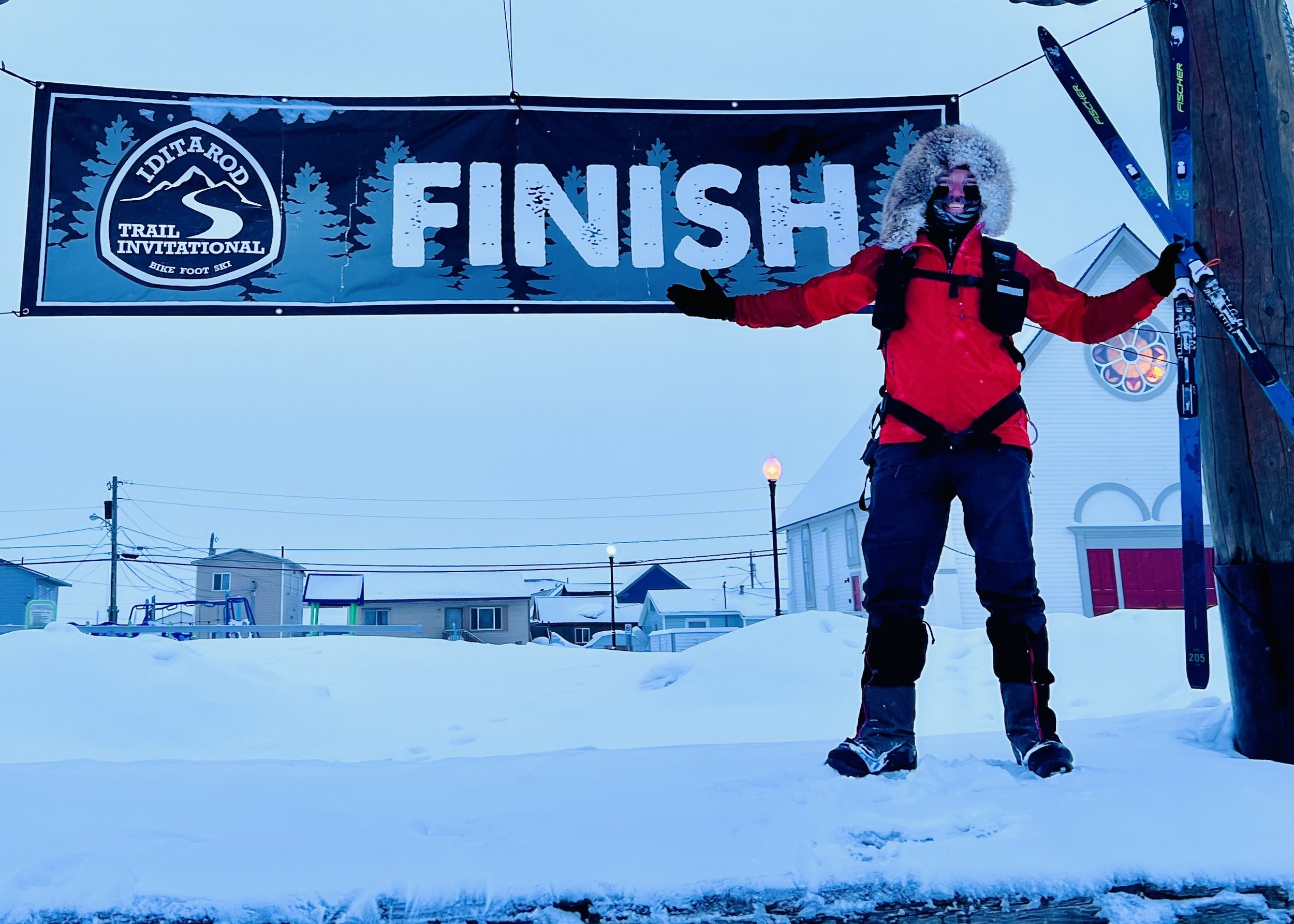
Taking a hard pass on a long 24-hour push, Sunny left Topcock around the same time as everyone else, but stopped for a nap at Safety before her final 22 mile ski into Nome. Sunny arrived in Nome at approximately 11:55 am today, plenty of time (3+ hours) to spare before the 30-day time cutoff. With her finish in 29 days, 23 hours and 6 minutes, she became the first female ever to ski the ITI to Nome. If we look back to Lars Danner’s blog about skiing on the route (http://larsdanner.blogspot.com/2020/07/skiers-who-have-skied-iditarod-to-nome.html), we see just two other women, and indeed only one that skied the full northern route. Let us all take a moment to commend Sunny on her monumental achievement; congratulations, Sunny! Hopefully she’s now taking in some well deserved rest and relaxation (and food, lots of food). 

Where to start with Sunny? She founded the AWE Summit Scholarship Foundation, originally created by women in order to break down barriers for women in the big mountain realm. Gender equity is at the heart of their mission and they strive to empower all marginalized genders. Sunny also manages the Foundation’s sister organization, AWExpeditions, a for-profit mountaineering and adventure guiding business for women, by women. AWExpeditions plans and leads the all-female climbs and adventures that Summit Scholarship recipients participate in free of charge. 

She entered the ITI 350 in 2021 with the eventual goal of skiing to Nome, then on her freshly purchased not-yet-3 week old pair of mostly unused skis. Did we mention that this was her first pair of skis? I was also skiing in 2021 and crossed paths with Sunny several times. I was struck by how well she took care of herself despite the challenges, something I could learn a thing or two about. 

While recuperating in Nome today, Sunny shared these thoughts. “It’s all in the mind. The physical challenge is just the stage for facing the emotional and mental challenge of doing something like this. In the end, I was juuuuust fit enough and just stubborn enough to keep on keeping on day after day - and at the end of the day that’s all you have to do in an event like this. If I can do this, so can many others.” I was thrilled to see she donated her skis to a local at the finish, though perhaps this was as much of a gift to them as it was to her?

As we contemplate the last 30 days, there were highs, there were lows, there were certainly edge-of-the-seat moments of anticipation as we watched racers overcome extreme cold, wind storms, blizzard conditions, overflow, rain, and so much more. Let’s take a look at the numbers.

Starters represented 11 countries from across the globe, including Australia, Canada, and several European countries. 103 starting athletes ranged from age 27 to 68 and were 78% men and 22% women. 42 athletes or 41% scratched. 66 starters were on bike, 27 on foot, and 10 on skis. Mean age was 45.5 with an even distribution more heavily weighted towards 36 - 43 years old. Of the 61 finishers, they were 18% women and 82% men. 65 people started the race for McGrath, and 38 for Nome. 

Looking a little more closely at finishers, they had a similar age distribution to above, with age 36 to 53 seeing the most finishes. In the 350 and 1000 mean age was 43.  Winners tended - but inconsistently - towards the younger end of the age range.

Sunny was the youngest (38) and only female ski finisher this year (and the first ever ITI 1000 female ski finisher). Ski finishers were generally a young bunch, with a mean age of 41 years. Amazingly, there were only two McGrath ski finishes, and five Nome finishes. 

Amongst foot finishers we see a similar trend, just four 350 finishers and seven 1000 finishers. Mean age of Nome finishers was 46, mean age of McGrath finishers was 44. Ryan Fox is an outlier at only 26, without him the mean age of this group is 51. Mean age of Nome finishers was 46, again with the lone female finisher also in the youngest age bracket of 42.

Numbers in the bike category are more robust, with a much larger sample size. In the 350, the mean age was 43 with 32 finishers. In the 1000 distance there were 11 finishers, mean age 42. Females here tended to be younger, 30 and 43. Top finishers tended towards the younger end of the age range, but 3rd place bike finisher Peter Delamere is 53.

I could spend all night playing with the numbers, but after religiously following dots for 30 days, the Wild Winter Women update writers are tired, the athletes are tired, race volunteers and staff are tired. We heartily congratulate all the racers and all their supporters. We may be back tomorrow for one more recap, and we’ll definitely be back next year to bring you the highs, the lows, and everything in between.

Sign up starts April 1, will you be there?

Author: Amber Crawford

Photo Credit: Iditarod Trail Invitational


Kari GibbonsComment
A Bevy of Finishers on the Last Day

It’s been a busy day in Nome as fans welcomed five finishers, all within the looming deadline of the 30-day mark. Kudos to these enduring athletes for braving the most severe conditions and successfully concluding their Iditarod Trail adventures to Nome!

Mark Hines finished in 29 days, 7 hours and 39 minutes for his first successful ITI 1000.

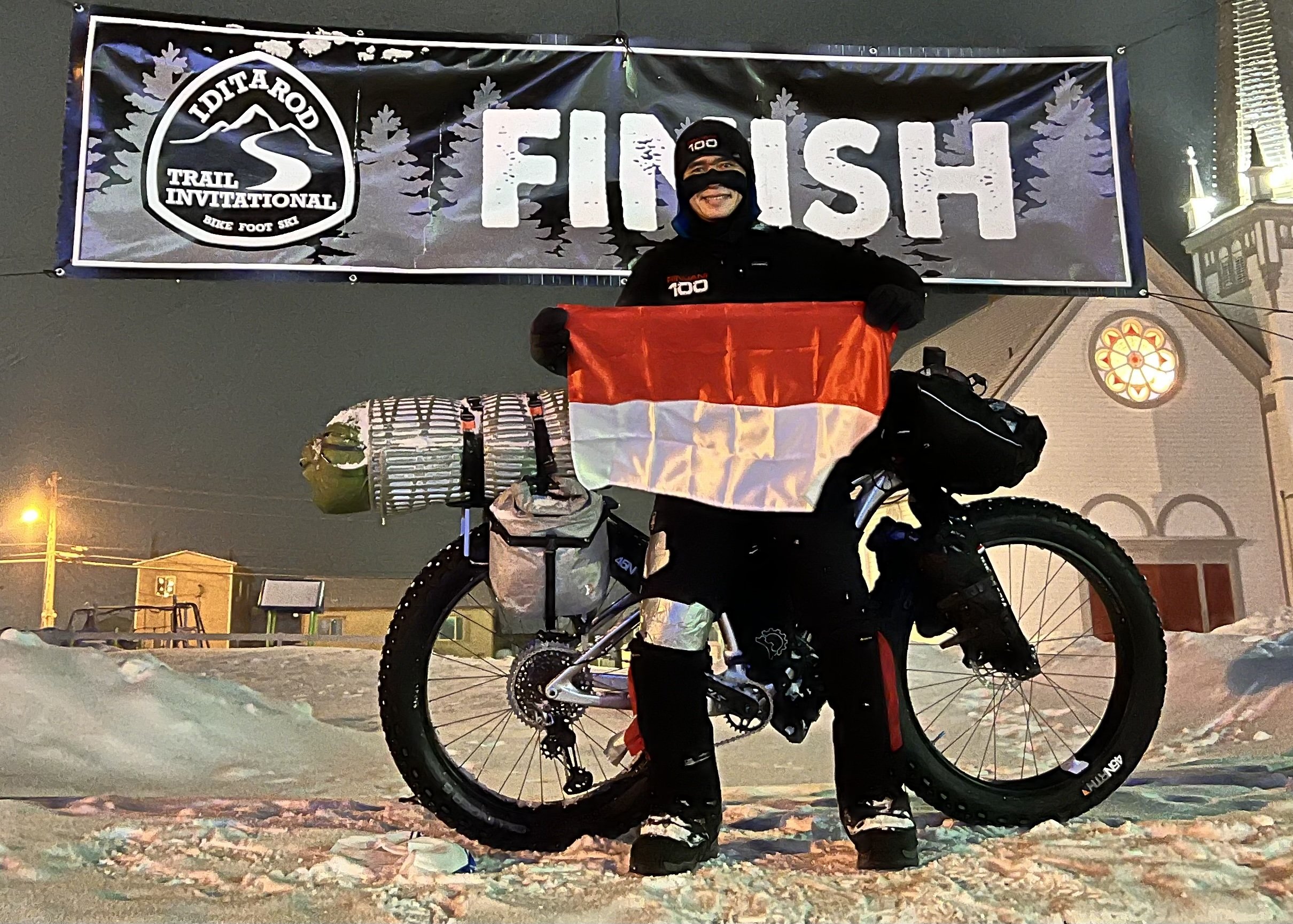
Hendra finished in 29 days 9 hours and 37 minutes as the first Indonesian to complete the ITI 1000.

Peter finished in 29 days, 17 hours and 43 minutes as the first person to finish the ITI 1000 on bike and skis.

Brandon finished in 29 days, 21 hours and 6 minutes for his first successful ITI 1000.

Sunny finished in 29 days, 23 hours and 6 minutes as this year’s Red Lantern, the Women’s Ski Champion and the first woman to complete the ITI 1000 on skis.

Kyle DurandComment
History is made, again!

Even though we are a small but mighty community of winter ultramarathoners, it feels like the whole world is watching our athletes traverse the last 30 miles of the 1,000 mile course.  Diligently refreshing the screen, hoping we can somehow will them on.  It all seems so doable, and yet, it is up to them to gear down and push through the last ultramarathon of the course.  

It was not strength alone but patience and presence of mind that got them all to this point.  Last night, Hendra, Joshua, and Mark were “stuck in the (Topcock) Cabin” trying to avoid the most brutal part of the weather, with the intention of leaving at midnight.  Even though it was frustrating for them, the wait definitely paid off. The infamous Blowhole still had enough to say with high winds but, according to Mark, it was “nowhere near as grim or dangerous as they would've been yesterday.”

Later, Sunny, Petr, and Brandon had a rest as well at Topcock Cabin totalling around eight hours.  The rest seemed to have done the trick for all of our athletes as all six have been moving consistently well throughout the day.  Petr, Sunny, and Brandon are less than 10 miles to Safety.  Mark and Hendra have passed through Safety and are on their way to Nome.  Remarkably, even though they all left Topcock together, Joshua Brown has put an incredible 13 miles in between him and his compatriots, and at the time of this writing, is two miles to the finish.  

This is not Joshua's first time to Nome.  He successfully completed the foot division race in 2022.  Once he finishes, he will become the third 1000-mile ski finisher in ITI history and the first person to finish the 1000 on foot and skis, even after having virtually no background in cross-country skiing until two years ago.  Completely new to skiing, Josh started researching what it would take to make it to Nome in 2022 and has been training ever since, including skiing for several hours in the morning before work and training with the Alaska Pacific University team in the evenings. When he wasn’t skiing, he was testing equipment and even creating his own out of raw materials. 

Known for his relentless determination and hard-working ethics, Josh is an active-duty Lieutenant Colonel who serves at Joint Base Elmendorf-Richardson as a medical advisor in the Air Force’s Arctic Warrior program. He helps develop new techniques and technology for the military to sustain operations in cold weather.  He enlisted in the Army as a medic nearly 20 years ago and later transferred to the Air Force as an officer after attending nursing school. He, his wife and their three kids live in Eagle River and spend a good deal of their leisure time exploring the Alaskan wilderness. 

If you remember from an earlier report, Josh had GI issues almost immediately from the start of the race, and went over 30 hours before he was able to fuel properly.  A similar issue from 2022 occurred when he developed food poisoning and ate very little for over three days on the Yukon. His body rejected almost everything he put in his gut but Josh did not stop.  Being able to work hard under adverse conditions is one of his super powers.

It isn’t all about participating in the race for Josh.  Last year he took off from racing in the ITI because he felt that it was important to give back to the community. So, he spent nine days running the Nikolai checkpoint with Jon Richner, another ITI and military veteran he has known for 20 years.  Rounding out this incredible athlete, he is “a humble, relentless and dutiful example that we would all do well to emulate.”  As it has been implied before, completing the ITI is not just a physical endeavor.  And it is more than a race.  Because of that, it calls to many of its participants to give back, by way of volunteering or mentorship among other things.  

For Josh, he has done the work and the research. He has run through the gauntlet of all Alaska has to offer this year, and he will make history very soon.  As RD Kyle states, “He just gets the job done, regardless of the obstacles faced and never makes a sound about doing it.”  We will all be watching, and it may not be the whole world, but it is OUR whole world.   

Written by Kari Gibbons

Intel of the illusive Johua Brown by Kyle Durand

Photo credit Kyle Durand


Kari GibbonsComment
Josh's Gritty Finish Produces Another ITI First

As Josh Brown made his way across the finish line in Nome after 29 days, 2 hours and 2 minutes on the Iditarod Trail, he became the first person to complete the ITI 1000 on both foot and skis. This monumental accomplishment came less than 2 days after it appeared he might be trapped by flooded trails and 24 hours after being pinned down by 60 mph winds on the coast. Demonstrating his characteristic resilience, Josh overcame those adversities, just as he had with all previous challenges along his journey. Ultimately, under the Burled Arch, he embodied the spirit of unwavering determination.

Kyle DurandComment
Two Days and a Little Bit.

For weeks now, the first thing I do in the morning is check to see where the racer's Dots are. Typically this is in the middle of the night for them, I document how long they have been tucked in and (try) to keep track of when they move. Yesterday and today however, there were no sleeping Dots, the last six athletes have consistently been on the move. Yesterday we saw increased speeds, racers in every division, foot, ski, and bike, were finally able to open up. We can actually feel the urgency they are experiencing. Collectively, they are moving when they can and pushing hard when they need to. Two full days and a few hours to the 30-day cutoff. 

This morning Hendra, Mark, and Joshua were 30 miles from Safety, currently they are all at Topcock Cabin 22 miles from Safety and 42 miles from Nome. Joshua arrived at the cabin first after a bivy of at least six hours today. Skiers often take the brunt of trail conditions because the margin of “good trail” is smaller, so I personally find it very satisfying that although everyone is finding improved conditions, skiers seem to be benefiting the most. 

Twelve miles further from the finish and on foot is Brandon, behind him, skiers Sunny and Petr. Sunny reported excellent conditions last night and a bit of “actual skiing”, they are all approximately 30 miles from Safety. These speeds and purposeful forward motion would be enough to secure a finish before the cutoff, but for the weather. Unfortunately another storm is imminent and they may need to hunker down. In the ITI Racers Facebook group Beat, eight times 1,000 mile finisher and literal opposite of the Boy Who Cried Wolf, sent out a warning for what’s to come. 

Once our athletes leave Topcock Cabin, even though the wind might seem manageable, they will soon be entering the infamous Blowhole, channels of cold air created by the mountains. Beat speculates what they will encounter will be severe. He noted “[c]urrently it looks like 40 mph gusting to 50 mph which isn't great. At least it's not super cold atm (14F) but there are probably near-whiteout conditions due to blowing snow.”

Athletes are fully unsupported now, previous towns and warm checkpoints are a distant memory. As the athletes have moved through this trail, they leave behind a massive effort of 38 volunteers and staff that have worked tirelessly to help their dreams become a reality. Whether it was serving one of the 1,200 meals that were prepared and served during the race, or monitoring the phone, email, and trackers 24 hours a day for 30 days, their jobs are nonstop until the race is over. 

As Race Director Kyle Durand states, “Organizing the ITI is like coordinating an athletic event while running an airline, a travel agency, a remote expedition and a B&B.”

Remember those delightful tents at Finger Lake and Rohn our athletes visited? Everything including food, tents, wood stove, sleeping gear, and more must be flown out to the checkpoint, set up, broken down, and flown back.  In 2021, flying everything back meant EVERYTHING including the multiple portaloos and their contents. It was all bagged, gathered, and packed into a plane. That might make the rest of the volunteer gig seem a little sweeter which consists of spending three days breaking trails, digging out the campsite and setting up the checkpoint.

There were six snow machines and 72 flights shuttling volunteers and gear, so when an athlete went over Rainy Pass, they were greeted by welcoming volunteers and a warm tent. They could crack open their drop bag and delight in the tube of Girl Scout Cookies packed weeks before (actual events). All told, for the duration of the race 17,500 pounds of material was moved across Alaska.

Everything needed is now in Nome, everything except our six remaining athletes. 

Two days and a little bit. 

Written by Kari Gibbons

Stats provided by Kyle Durand

Photo credit Kyle Durand


Kari GibbonsComment
“Reach out of the darkness…” - Friend & Lover

What makes the ITI “so groovy” is the community around this event.  It really is about “people getting together.” (https://youtu.be/RBjQhEME0LQ) That’s what resonated with me as I read recounts of athletes’ experiences and heard how community members from Elim to Nome have rallied around those who are still on the trail. This sense of community is found in something as simple as a Facebook message from Joanne Wassillie inviting her friends in Nome to cheer on the three amazing athletes in the home stretch last night and this morning.  And then that sense of togetherness - that “reach[ing]] out of the darkness” - was amplified by learning the mayor of  Elim heard our racers couldn't get to Golovin because of the 3+ feet of fresh snow that had fallen, so rode his snowmachine from Elim to the Golovin Bay and back so they had a trail.  Frank Amaktoolik Sr. in Golovin has been meeting racers coming off the ice and escorting them to the school. There are a number of reasons why the ITI is just a spectacular event from the landscapes, challenging conditions, our fellow athletes, but for me, what has really made it almost beyond comparison (“almost” because I just compared it to Barkley yesterday and I can’t be a complete hypocrite) are the people in the communities, at the roadhouses, all of the “trail angels” that we get to meet along the way. They “reach out of the darkness” and, as Ryan Wanless commented, even when “you feel like you’re all alone…in truth there are people all over the trail supporting and following your adventure. You are never truly alone. The support is enough to fill one’s heart.”

In that spirit of togetherness, let’s celebrate the three incredible athletes that ended their voyage from Knik to Nome since yesterday’s update. 

This morning under swirling rivers of greenish-blue light, Leah Gruhn finished her second ITI 1000 (26 days, 10 hours, 6 minutes) and was the second woman this year to complete the journey on bike.  The aurora, however, wasn’t her only escort to the fabled burled arch. Hearkening back to our amazing community, the mayor of Nome must have done a little dot watching of his own (you’re in good company, Mayor Handeland!) because he also accompanied Leah to the finish.  Leah reported that “the whole thing was brutally hard and took every last bit of willpower [she] could muster, plus the support and love from MANY.” Once again, congratulations Leah Gruhn! You are an inspiration.

Our winner of the women's foot division, Faye Norby, arrived in Nome after 26 days, 19 hours, and 6 minutes on the trail.  Just nine hours after her own finish, Leah Gruhn was out cheering on Faye and her partner, Jeff Leuwerke.  Faye is a consummate athlete.  She’s been competing in winter races for over ten years, with experience racing Tuscobia, Arrowhead 135, Actif Epica 100 miler, and the ITI 350.  What you may not know about Faye is that she is also an epidemiologist. So you won’t be surprised by her answer to the question of “what does the ITI mean to you?” For Faye, the ITI’s connection with the 1925 Serum Run is what made this race so special. For those who don’t know, the Serum Run was an incredible public health story that once again reiterates the power of community.  

A century ago there was a diphtheria outbreak on the west coast of Alaska.  Curtis Welch, who was the only doctor in the area, put out an urgent request for diphtheria antitoxin after he realized the region’s entire supply of serum had expired. A thousand miles away, there was a stockpile of serum in Anchorage, and a plan to transport it came together. A parcel containing the serum left Anchorage on the Alaska Railroad bound for the small town of Nenana, in central Alaska. From there, a relay made up of 20 mushers and around 150 dogs took over, and using established mail and freight routes, raced the serum westward 674 miles to Nome. These teams braved extreme cold and dangerous conditions to transport the serum in only 5.5 days. The epidemic was halted and lives were saved.  For Faye, once she arrived in Ruby on the Yukon River, she followed a similar route to Nome that the serum traveled 99 years ago. And so she was proud to have the privilege of traveling a leg of this same remarkable journey. Congratulations, Faye, for being more stubborn than the weather and the trail and being this year’s women’s foot champion!!

Faye was not alone on her journey.  Every step of the way, she traveled with her partner, Jeff Leuwerke.  He also is no slouch in the winter ultra realm, finishing the Tuscobia 160 six times, Arrowhead 135 twice, Actif Epica twice and the ITI 350 twice.  When asked to share a bit of wisdom when things are looking dark, Jeff said that it’s important to remember that “it’s almost always never going to get worse. More than likely, it’s just time to eat some food, maybe have some caffeine, or take a quick three-minute sled nap.”  I’m pretty sure Jeff had to follow that advice a number of times over the last 26-plus days.  Congratulations on your amazing finish, Jeff!

There are still six very motivated racers on the trail with less than three days to get to Nome.  Sunny reported this morning that the trail had set up well with the temperature drop.  Once they reached Golovin, Frank Amaktoolik Sr. made sure they all had breakfast. Hendra Wijaya is currently leading our merry (I may be overly optimistic) conga line of athletes at mile 892 with Joshua Brown not far behind.  Sometimes having a bike can be beneficial and today seems to have been one of those days.  Hendra reached speeds over 7 mph today crossing Golovin Lagoon and Joshua Brown wasn’t much slower.  

Mark Hines, on foot, did not reach a speed of 7 mph today.  But he did keep a pace well over 3 mph for a good part of the day.  He’s currently resting in White Mountain alone.  But not for long.  “People are getting together” with Sunny Stroeer, Brandon Lott, and Petr Ineman on their way to join Mark soon.  I hope they all get a good rest and enjoy the hospitality of some of the amazing trail angels because they’re going to need it.  There’s a winter advisory which goes into effect at 10PM tonight and remains in effect until 4AM on Monday with snow and blowing snow and (blech!) freezing rain possible.  Wind gusts as high as 40 mph are expected.  Hendra and Josh made the smart move to press on while they could.  Equally smart is for our remaining ski and foot athletes to get a good rest (but not “too” good) before they again venture out in the darkness.  Hopefully by now they know that they are not alone.  They just need to “reach out in the darkness” and they will “find a friend.”

Written by Carole Holley
Photo credential: Cynthia Durand

Kari GibbonsComment
Faye Triumphs as the Women's Foot Champion

In a breathtaking display of endurance and tenacity, Faye Norby became the only woman to finish the Iditarod Trail Invitational on foot this year, clinching the Women's Foot Champion title. Her incredible journey of 1000 miles through some of the most unforgiving landscape on Earth concluded under the iconic Burled Arch, with a finish time of 26 days, 19 hours, and 6 minutes.

Faye's final moments on the trail were illuminated by the northern lights weaving across the sky and the full moon lighting her path, creating a scene of otherworldly beauty. As she crossed the finish line on a frosty morning, the sun rose over the Bering Sea, casting a radiant glow across the sky.

This victory is more than a testament to physical strength; it's a story of unparalleled mental fortitude. Being the sole female to complete the ITI on foot this year, Faye's accomplishment highlights her extraordinary resilience and the indomitable spirit required to face the challenges of the Alaskan wilderness.

Congratulations, Faye, on your remarkable achievement as the Women's Foot Champion and the only woman to conquer the ITI on foot this year! Your journey through the wilderness, guided by the northern lights and the moon, to that final, victorious moment under the Burled Arch, stands as a beacon of inspiration and courage.

Kyle DurandComment
Jeff Prevails in Nome

Jeff Leuwerke triumphantly crossed under the Burled Arch in Nome after a grueling 26 days, 19 hours, and 6 minutes, marking his inaugural finish in Nome and his third successful ITI. Throughout the expedition, Jeff braved the extreme forces of nature, from gale-force winds and prolonged periods of sub-zero temperatures to rain, snow, and virtually every conceivable challenge the Alaskan winter could present. As he met the finish line on a chilly morning, the early sun painted the Bering Sea in a golden light, heralding his remarkable achievement.

Kyle DurandComment
Leah Does it Again

Leah Gruhn finished her second consecutive ITI 1000 when she crossed the line in Nome in 26 days, 10 hours and 6 minutes. She arrived with an escort by the Northern Lights and the Mayor of Nome. Congratulations Leah on your massive accomplishment during a very challenging year on the Iditarod Trail!

Kyle DurandComment
What Barkley and ITI have in common…

One might not immediately draw the connection between a foot race in a Tennessee state park, which draws its origin story from a prison break, and a multi-modal race that covers nearly 1,000 miles of frozen Alaskan landscape based on a serum run by dogsled. But allow me to explain. First, both draw the attention of (at least in the beginning with Barkley) a quirky subset of the ultra community. Some part of us is drawn to the amount of suffering that must be overcome, the strength of will to keep pushing despite staggering obstacles, sheer awe for those who toe the line, and we are in complete agreement that the few finishers (26 since 1995 for Barkley (only one woman) and 148 (give or take) for the ITI since 2000 (only 14 women…so far) are 100% bada$$. Both require a measure of self-sufficiency and survival skills not often encountered in modern day North America and Europe, let alone during an endurance race. The elements are key factors in both races; favorable conditions can lead to substantially more finishers than a year when wind, hail, snow, rain, sleet, choose your own weather adventure, are pervasive. And, finally, they draw our collective attention, imagining every move of the athletes  without actually being able to observe them. 

Barkley finished this afternoon 60 hours after it began with five finishers, one being its first female finisher in the history of the race, Jasmin Paris. The ITI will conclude in four short days. I split my time this week between work, obsessively watching ITI dots and (since Wednesday) checking whatever obscure updates for the Barkley Marathon I could find through social media. Much like I experience joy when we have a finisher in Nome, I was emotionally invested in the Barkley finishers, most especially the “small European woman” as Jasmin was described in early reports (Barkley has a distinct culture much like we do). I celebrate all, l but it’s an even more profound sense of joy with our Wild Women finishers. Speaking of which, we should have another one soon!

Leah Gruhn, on her way to her second finish, is only 17 miles from Nome. She spent last night in Tommy Johnson cabin at mile 917. Reports from the Trail indicate the overflow was significant between Topkok and Tommy Johnson’s cabin with reports of knee-deep water along Taylor Lagoon. Joanne Wassillie reported that “the weather turned: got warmer, rained, wind, more wet snow. The trail is TERRIBLE…more wet snow and you can’t see the hills toward Nome.” So, a stay in a cabin - no matter how rugged - may be the wisest choice one can make to dry out a bit. Firewood is likely scarce with driftwood the only potential heating source. When we realized that Leah had been walking almost the entire time since she left White Mountain, we may have imagined a dream sequence that included Faye, Jeff, and Leah all crossing under the burled arch together hand in hand, perhaps singing Hobo Jim’s famed Iditarod Trail Song (https://www.youtube.com/watch?v=F_ZbOqFRnxw)...that last part might just be me.

Faye Norby and Jeff Leuwerke rested at mile 896 last night. We heard they were unfortunately both soaked through. The weather deities have not been kind. Luckily, the weather may be improving with temperatures in Nome falling to the mid-20s this evening and a high of 22F tomorrow. This should help all those liquid elements to refreeze for the remaining athletes. Jill Homer calculated this morning that if Faye was able to average 3.03 mph from last night onward, she would be able to break the women’s record. Unfortunately, given the trail conditions, that’s highly unrealistic. And much like Faye barely missed beating the women’s record to McGrath in 2022, it seems as though this year might prove to be equally frustrating. Faye and Jeff are now moving at about 2.1 mph and are 13 miles from the Safety Roadhouse, which is unfortunately closed after the Iditarod Sled Dog Race. But they’ll be that much closer to Nome and Faye (while not the first woman on foot to finish ever, in contrast to Jasmin Paris), will be the first woman on foot to finish in a decade since Loreen Hewitt and Shawn McTaggert finished in 2014.

Joshua Brown and Brandon Lott seem to be resting at mile 845.3 and the Walla Walla shelter cabin. They both appeared to have at different times attempted to leave and then returned back to whatever relative safety the shelter cabin offers. The cabin is located eight miles south of Elim and a mile or two onshore. At Walla Walla, the trail turns inland and climbs over the Kwiktalik Mountains with a series of long, moderately hard grades. The final summit is 1,000 feet at Little McKinley, about eight miles past Walla Walla and ten miles from Golovin. This is considered the hardest climb on this part of the race.

Mark Hines reported that he spent 25 hours going 43 miles with persistent rain wiping out the trail. He rightly had safety concerns over bay crossings and eventually turned around and headed back to Elim after attempting to forge ahead in white-out conditions. He then seems to have gone back out on the ice. He’s currently only four miles from Walla Walla cabin going 1.1mph. That’s a slog. At least he will soon (or in four hours at that pace) have company.

Hendra Wijaya decided to spend some time post-holing his own path earlier today…a hillier trail that may have seemed worth the gamble when facing slushy conditions on the sea ice. Unfortunately, Hendra lost whatever trail there may have been and encountered deep snow in the woods. He thus had to backtrack with Mark Hines and headed back to the safety of Elim. He too has headed back out in an effort to get to Walla Walla. He’s about seven miles out, traveling at 1.7mph. If he can keep that pace, he won’t be too far behind Mark and crashing the party at Walla Walla cabin.

Petr Ineman and Sunny Stroeer round out our intrepid athletes. (After watching Sunny’s video from yesterday, some dot watchers felt like curling into a ball for self-preservation (and we’re in the comfort of our own living rooms.) Petr reported experiencing the same wet conditions as everyone else. Sunny confirms the reports, describing the trail conditions as “terrible - super saturated, unstable, [and] postholing even with skis on.”  Both are currently resting in Elim, hopefully commiserating, drying out, and eating before getting a nap and preparing for cooler weather and firmer conditions tomorrow when  Sunny and Petr hope to catch up with the others to form a wintry conga line (love me some Gloria Estefan…https://www.youtube.com/watch?v=54ItEmCnP80) all the way to Nome.

Barkley may be over but we still have four more exciting days of ITI with what I am hoping includes three more Wild Winter Women finishers along with their male compadres of the trail.

Written by Carole Holley
Photos from Sunny Stroeer

Kari GibbonsComment
Overflow, basketball, and five more ITI finishes!

Our 1,000 mile foot champion Gavan bivied last night for about 8 hours along the Klokerblok River, which flows in an easterly direction and joins Fish River in its delta mouth. It was exciting to wake up this morning to see Gavan and Ryan on the move, typically athletes are all tucked in and resting this early but it seems everyone is eager to get on their way! We have got to give a nod to this year’s ITI finish photos - we love seeing these athletes have so much zest and pep left in them after so many days on the side of the trail. We must say that Gavan looks incredibly happy to have finished!

Ryan Wanless has had his heart set on finishing on Friday so that he can watch basketball stress-free and cozy and warm.  Gavan reported a horrible last push overnight. Alaska delivered sleet, rain, and snow, and left our racer wearing a plastic garbage bag like a proper vagabond. To help make this difficult push, he devoured 600mg of caffeine to fight off the sleepies. We might not advise that technique in the cold to get to Nome, but in this specific scenario it appears to have been the right move! Finishing in time for breakfast and the sunrise sounds absolutely dreamy. Ryan Wanless’s basketball team is the Wisconsin Badgers, go Bucky!

Christof, Beat, and Jan were also up and at it after shorter, 3-6 hour breaks, at the cabin. Leah stopped to bivy roughly 10 miles from the Topcock hills cabin, electing to sleep in the wilderness before making a push in the morning to the shelter for lunch.

Jan updated late last night after arriving at the Topcock cabin and shared excitement that he had finally made it to the shelter! Yesterday there was heavy, deep snow, which required him to hike in the strong winds. He arrived at Topcock in the daylight and was pulled to continue, but knew that the Safety roadhouse would require him to sleep outside (which is nonsense, he says!) The temperatures climbed to zero and there is a lot of overflow along the trail. The wind was not subsiding, which he felt was Alaska’s own way of saying, “Goodbye” as he made his way closer to Nome. This evening we see these three finishing after a magnificent effort and it marks five finishers on day 25 on the trail. Congratulations!

Leah Gruhn is in her own words, was “Less than an Arrowhead 135 away from the finish” which speaks volumes about her as a winter ultra athlete, doesn’t it?! She is mentally one of the toughest humans we know and we cannot wait to celebrate with her once she makes it to Nome. Check out the podcast We Do This For Fun and listen to her episode if you’re interested in learning more about what life on this trail is composed of. With winter being a little bit of a dud in the Midwest this year, Leah is braving the elements and filling her cup with more winter than she knows what to do with out there. With a quick visit to the Topcock Hills cabin, she left as soon as she could to make her way towards Safety. 

This episode of the podcast is from her adventure on the trail last year so it’s a good time to brush up before hearing about her experiences once she finishes! In this episode replay, we hear what it takes for an athlete to finish the ITI: it is not primarily a solo mission. It takes the support from family, friends, and community to get ready to compete. Thanks to Leah’s support network, she is able to participate in this multi-week expedition. All of the athletes out racing Iditarod Trail Invitational have someone or a group of people that helps to get them to the starting line, and for that we want to mention our gratitude. Leah also speaks of serendipitous moments out on the Iditarod trail, sharing experiences with other Minnesotans while listening to Bob Dylan, meeting family friends out in the vast villages. How many calories does it take to get to Nome? That definitely depends on who you’ve asked, but for Leah Gruhn in 2023 she packed 88,000 calories in her drop boxes alone. Our friend is steadily moving forward and we cannot wait to cheer for her in Nome! Will she finish her push tonight or finish on day 26? The suspense! 

https://www.wedothisforfun.com/episodes

For the rest of our athletes, it has been a very damp day. From Koyuk to Elim, we’re seeing moderate winds and high humidity. It’s snowing in some spots, but a wintry mix in others. Gavin arrived in Nome wearing a garbage bag and we imagine our friends along the trail are wearing similar ensembles. A winter storm warning is issued for the Interior Seward Peninsula and remains in effect until 1pm on Friday. The National Weather Service has forecasted heavy snow, and accumulations up to 3 to 8 inches with wind gusts up to 45 mph. Areas of blowing snow could significantly reduce visibility for all trail users. The Iditarod trail is technically more along the coast in this region and out of this zone but we can’t imagine that means blue skies and easy sailing for our bunch. They’re dealing with some wet damp stuff, and in the words of Petr Ineman, “This is how you get hypothermia.”

In addition to the winter storm warning, there is significant overflow along the course, especially in areas along the sea ice. Sunny shared a photo of the trudge through shin-deep water as she traveled through Norton Bay through the Koyuk Inlet. Faye mentioned yesterday that there was water coming up near Golovin Bay just before reaching White Mountain, and Leah noted that the section turning off of the Fish River after White Mountain was one of the worst stretches. There are 8 athletes who have not gone through these areas yet, and we hope that things dry out a little before they get too soaked.

Faye and Jeff are moving along after moose meals in White Mountain, in the area that Leah described as the worst. These two have been traveling together and have been sending updates when they can. They arrived in WM past 3am, and it was a looong day. The bay crossing from Golovin was rough and they decided to get it over with in case the ice got worse. There were already spots off of the trail that had water coming up. It snowed, rained, and sleeted on them the whole time but luckily the wind remained a tailwind, helping them through the tough conditions. Visibility was challenging for most of the trek, and they were absolutely soaked when they got to the village.

Faye did the 350 mile on foot in 2020 and in 2022, which were both vastly different experiences. Her first year saw very difficult and snowy weather which was very physically demanding. When she went back in 2022, it was a warm year with good weather, and the skills needed were very different, although the trail was much less physically demanding. Jeff also did the 350 in 2020 and in 2022, and described his first experience as a surreal experience of finishing and realizing the world was beginning to shut down due to the pandemic (and lots of moose). In 2022, he realized he missed much of the landscape on his first adventure, as he was able to see it because it wasn’t snowing!

Brandon Lott has spent nearly 12 hours in Elim, possibly drying all of his gear. Hendra arrived this afternoon and they are both in the village eating burgers and no doubt watching the weather. Joshua Brown is roughly 14 miles from these two as of 5pm. With a slowed pace due to overflow, we’re hoping he’s able to get to the village to warm up for a nice long rest. Mark stopped at the Kwik River for a brief moment before getting back on the trail. Behind him, we have Petr and Sunny on skis, astounding us with their tenacity and ability to keep moving forward. Sunny’s social media has been updating us on conditions out there and we can only describe them as, “No. No. No. That’s so scary.” We wish these athletes all the very best this evening as we wind down and get ready for bed. Our dreams will no doubt be full of blue ice, slushy waters, and sleet.

Written by Jill Martindale
Photos from Sunny Stroeer, Gavin Hennigan, and Jan Francke

Kari GibbonsComment