
Day 8: In Like a Lion
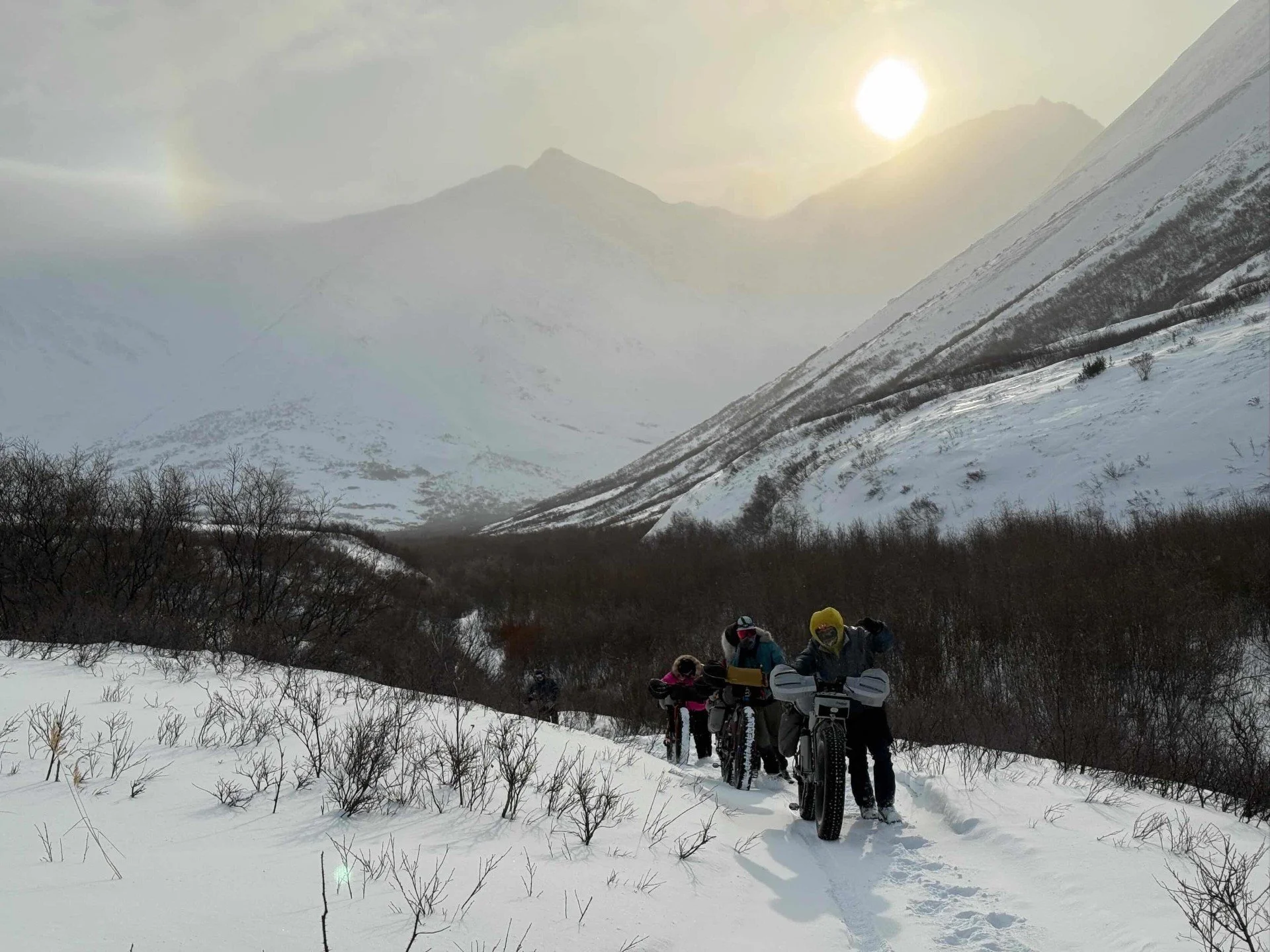
Photo by Ignacio Pellejero
3/1/2026
The 18th-century phrase "in like a lion, out like a lamb" describes March's shift from winter's bite to spring's gentler days. This year, March arrived in the Alaska Range roaring.
As previously reported, frigid air swept across the Alaska Range on Friday, with temperatures plunging as low as -45°F and winds estimated at 40 mph on Rainy Pass — one racer reported consulting a wind chill chart that put the apparent temperature near -107°F. A NOAA meteorologist volunteering in Nikolai (thank you Jonathan) calculated wind chills approaching -70°F at Rohn early Friday morning. The deep cold held firm through the weekend. Sunday brings only marginal relief, with air temperatures hovering around -20°F in Nikolai — and likely closer to -30°F along the river corridor.
But, as is tradition, we begin tonight’s update with celebration, before circling back to tales of the lion.
Congratulations to Ellen Humberston (Wausau, WI) on her imminent finish as the ITI 350 Women's Foot Champion! Ellen left Nikolai around 4:00 AM Sunday after a short night of sleep and made one final strong, steady push along the overland route into McGrath. While Ellen is just now crossing the threshold to ITI veteran status, in her pre-race survey she humbly named "self doubt" as her biggest challenge in race prep. We'd say she put that doubt to rest in a big way. She also reflected that "the journey of learning to support yourself and the confidence you gain is amazing" — and after a beautifully executed race in one of the most brutally challenging years in recent ITI memory, we imagine that confidence has deepened considerably. We are so inspired by Ellen's journey and can't wait to hear more from her in post-race interviews.
Celebrating other recent finishers: Tremendous congratulations to Scott Hoberg (Duluth, MN), winner of the men's 350 foot division and 2x foot champion. Scott executed a smart, strong race from start to finish. This victory was hard-won and well-deserved.
Congratulations to second place men's 350 foot finisher Jason Mancini (Metuchen, NJ). Jason revealed in his pre-race survey that he chose this event because his wife said "this would be safer than climbing Mt. McKinley." The jury is still out on that one, but by all accounts Jason finished unscathed. Paul Turner is also expected to finish this evening, rounding out the men's 350 foot podium.
Today’s additional 350 bike finishers included Jamie Hollingsworth (Fairbanks, AK), Michael Braniff (Anchorage, AK), Frederick West (Anchorage, AK), Michael Cook (Eidsvoll, Norway), and Luke Kiskaddon (Anchorage, AK).
Every finisher carries their own story to the start line, but some carry the weight of others with them every mile. Jamie Hollingsworth is one of those racers. Here he is in his own words: "About five years ago, my family's life changed forever when my wife Teresa was diagnosed with colorectal cancer. She passed away this past May. Colorectal cancer is now the leading cause of cancer-related deaths for those under 50. The struggle to get to this race is nothing compared to what people go through with colorectal cancer. If I can impact one person, all my training has been worth it. The Colon Cancer Coalition is following me in this race to help raise awareness, as awareness and prevention is key. Please consider donating at coloncancercoalition.org." Jamie, we are in awe of your strength on and off the trail. Thank you for inspiring us with a race with such purpose.
Behind these finishers, more are expected in McGrath this evening in the men's 350 bike division as follows: Mark Selland (Anchorage, AK), Cameron Lawson, Joaquin Candel (Las Vegas, NV), Derrick Seys (Geneseo, IL), Tristan Carlson (St. Paul, MN), Andy Weinzierl (Duluth, MN), and Matthew Webb (Farmington, MN).
Honorable mentions to Gavan Hennigan (Ireland), men's 1,000 foot, and Erick Basset (Caen, France), men's 1,000 bike, who both reached McGrath on Saturday evening, en route to Nome. Takao Kitada (Osaka, Japan) is also expected at McGrath tonight.
Still on the trail between Rohn & Nikolai four women remain: 350 foot athletes Sunny Stroer & Gillian Smith, and 1000 bike division Kendall Park & Mayella Kraus. We have heard reports that Kendall & Mayella slowed their race progress to assist other athletes in the past few days, but they are still progressing forward steadily.
As endurance athletes, we train ourselves to expand our capacity for discomfort. When energy reserves are depleted, muscles are aching, and sleep deprivation clouds judgment, we may even tell ourselves: Keep going. This is temporary. Anyone standing on the start line of an event of this magnitude has almost certainly developed an extraordinary ability to endure hardship.
But there is a line.
When discomfort begins to cross into true danger — to life or limb — racers must discern which internal voice to heed and which to quiet. They must make that call while exhausted, cold, and far from easy help, and decide whether the suffering of the moment is truly temporary — or something more lasting.
One racer, arriving in Rohn on Friday evening before scratching, put it plainly: "I had to make the tough decision to scratch at Rohn. I'm trying to learn the difference between suffering and causing permanent injury." That distinction lies at the heart of winter ultra-endurance sport.
Today, the scratch list stands at 47 experienced winter athletes. We've received reports of cold-related injuries and racers requiring assistance from fellow competitors on the trail — most of the injuries were caught early by athletes who trusted their instincts and made difficult but wise decisions to end their races. We wish each of them a smooth recovery and hold their decisions in deep respect.
We heard today from Tracie Curry, women's 350 ski division athlete and reigning 2025 ski champion, who scratched last evening in Rohn. She shared that this year was a learning experience, but she is already planning to give it another shot. We have no doubt she will.
It's been said that nothing in life is certain but death and taxes. Wilderness adventurers might add a third: nature always bats last. Those who venture deep into remote wilderness understand this unspoken agreement — conditions may be serene or severe, and they can change in an instant. We cannot dictate what the landscape delivers; we can only respond with the tools, judgment, and preparation we carry. And sometimes, the very systems that worked flawlessly in one race fail us in the next.
Winter racing resists predictability. The variables are staggering: metabolism, blood sugar, hydration, electrolyte balance, accumulated fatigue, sleep deprivation, temperature swings, wind, precipitation, trail softness, snow age, glide, physiologic stress, wildlife encounters, and an endless matrix of gear decisions. Even for veterans who have finished the ITI many times, it is nearly impossible to have the same race twice.
Nearly every iteration of the ITI brings at least a few days of harrowing weather or trail conditions. This year stands apart. The deep freeze paired with ground blizzard conditions arrived precisely when the largest concentration of athletes across all divisions were stretched over more than 125 miles of remote trail — a section combining higher elevations, exposed terrain, and technically demanding travel through remote mountain wilderness.
To even stand on the start line, racers complete challenging qualifying events, submit detailed applications, and accept race rules stating that "evacuations and medical services, if necessary, are solely the athlete's responsibility" and that "you, alone, are responsible for the consequences of your decisions while participating in the ITI." Preparation, sound decision-making, and self-reliance are not optional — they are foundational. A coordinated evacuation of a large field across that distance and terrain is simply not feasible. Each athlete carries not only their gear, but the responsibility for their own judgment — and the will to help a fellow athlete should the need arise in spite of every athlete’s best preparation.
The lion has indeed been loud these past few days. The decisions made in its presence have required clarity, humility, and a different kind of courage. For the 'Nomers' who may head out soon beyond McGrath, 700 miles of trail still remain, with weeks of unknown conditions ahead. No one knows whether the lion will continue to roar through the interior and to the coast, or whether the lamb will make an early appearance, but it may not matter much. They have likely already accepted that nature bats last, and that they must take in stride whatever they are given each day on the trail.
Update written by Allison Carolan
Thanks to Wild Winter Women - Amanda Harvey, Faye Norby, Jan Redmond Walker, Jessica Roschlan, Kari Anne Gibbons, Laura Wiesmann Hrubes, Leah Gruhn, Lynn K Hall, Madeline Harms, Rashelle Hintz, Rebecca McVay-Brodersen, and Sarah Bergstrom.