
Day 19: The Muddle in the Middle
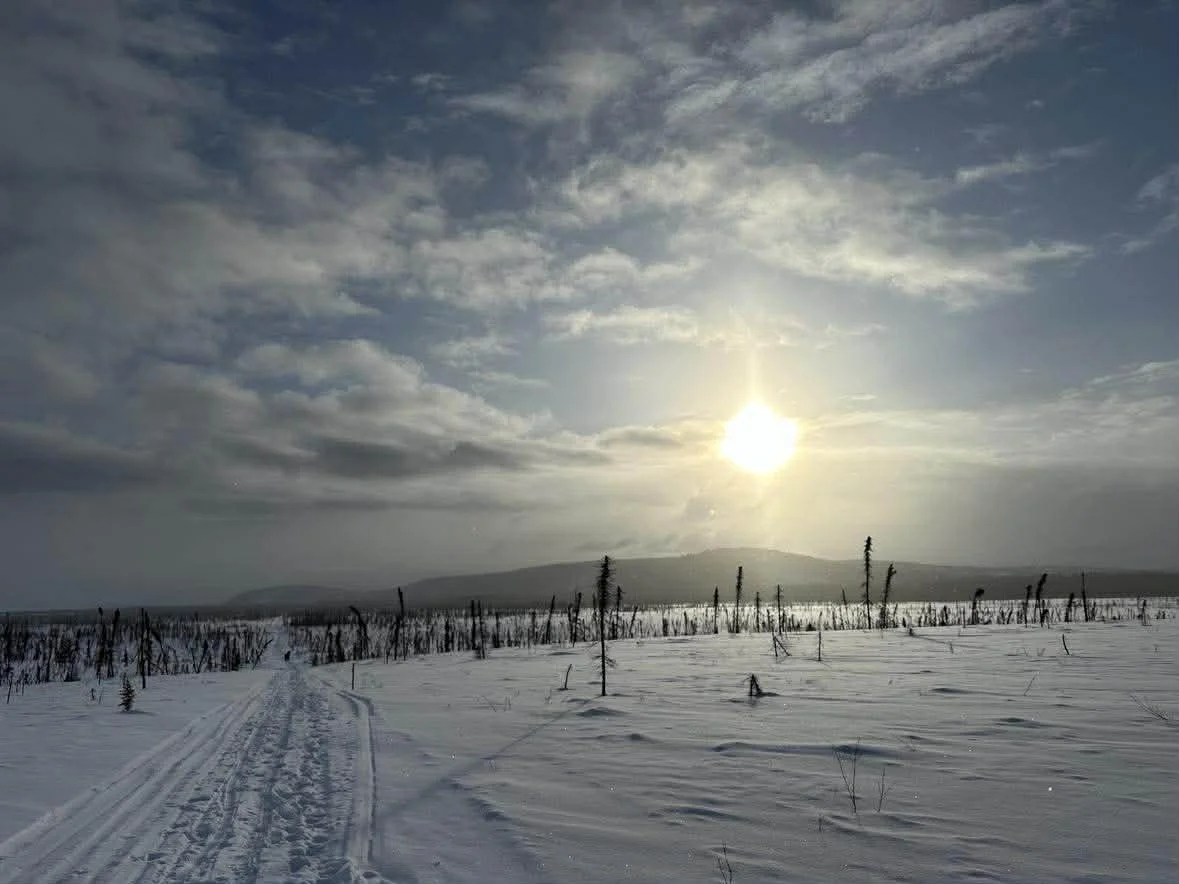
Iditarod Trail landscape of gently rolling hills through the interior rear Cripple checkpoint (photo: Leah Gruhn)
When it comes to winter ultras, or any long endurance event really, it’s often not the last few miles or hours that are most difficult; rather, it’s the middle, slightly before or around the halfway point. When you’ve been out for a long time, you’re bone-tired, and not even halfway there, it takes a great deal of mental strength to convince yourself to continue on. This year, ITI 1,000-mile racers have the added complexity of having had to wait for trail breakers for several days in variable conditions, which killed any momentum that they had previously. Now that the trail is passable, they need to put in big miles to reach Nome by the 30-day cutoff. The six individuals left on course are currently racing to the next checkpoint at Ruby (mile 495) on the Yukon River and are over halfway along the ITI 1,000-mile course.
As of 2:30 pm AKT, Gavan Hennigan (foot) leads at 457 miles. Gavan has been pressing on at a relentless pace since the trail breakers came through a few days ago, having covered 30 miles already today.
Troy Szczurkowski leads the bikers at 441 miles. Troy has finished the ITI 1,000-mile race six times before and is rumored to be making a move for the win this year. Both Gavan and Troy stopped only briefly at the Cripple checkpoint (422 miles). Mayella Kruse, Kendall Park, and Ryan Wanless rested for a couple of hours at Cripple and are now back on the trail around the 430-mile mark. Erick Bassett lost his tracker but is said to have left Cripple about 45 minutes before Ryan. He is hoping to get a new tracker at Ruby.
The Cripple checkpoint, where some athletes choose to pick up their drop bags (literally dropped from an airplane!) was laid out differently this year, with some food and fuel on the trail and some at the checkpoint, giving racers the choice for where to resupply and leaving it to them to decide if they wanted to take the longer route which would allow them to visit the dog sled checkpoint of Cripple. Because this stretch of trail is so rugged and isolated, the race director wanted to ensure athletes had plenty of food and fuel, as well as multiple options to get them.
It might seem puzzling that a foot racer is leading the ITI, but the unusual weather and trail conditions can explain this. Challenging trail conditions are much more disruptive to bike than to foot athletes, so most bike athletes chose to stay (or even backtrack to) McGrath (mile 310) until trail breakers came through, knowing they could pick up the pace once the trail was established. Meanwhile, Gavan (foot) chose to push through the poor conditions to mile 370ish before trail breakers reached him, knowing that on foot, he can’t put in huge miles like the bikers can when conditions are good. It will be interesting to see whether he remains in the lead to Nome or if the bikers pass him at some point.
The 200-mile section racers are currently traversing (McGrath to Ruby) is called “the interior,” and many former racers consider it to be the most rugged and challenging section of the 1,000-mile ITI trail. It is mentally challenging because it’s far enough in the race that the racers are getting tired, and far enough from Nome that it’s possible to question whether they will ever get there. It is so remote; after Takotna, there are no inhabited villages along this portion of the trail. There are only a few ghost towns, abandoned cabins, and occasional reminders of the region’s gold mining history. From Ruby, racers will follow the Yukon River for two to three days. Hopefully, the river is well packed, and the snow is not drifted. If the surface of the river is packed snow or ice, conditions will be fast for the bikers. Stay tuned for what is turning out to be quite the race against dog teams, cutoffs, and Nature herself!
Written by Madeline Harms
Thanks to Wild Winter Women - Allison Carolan, Amanda Harvey, Faye Norby, Jan Redmond Walker, Jessica Roschlan, Kari Anne Gibbons, Laura Wiesmann Hrubes, Lynn K Hall, Madeline Harms, Rebecca McVay-Brodersen, and Sarah Bergstrom.