Twinning is Winning

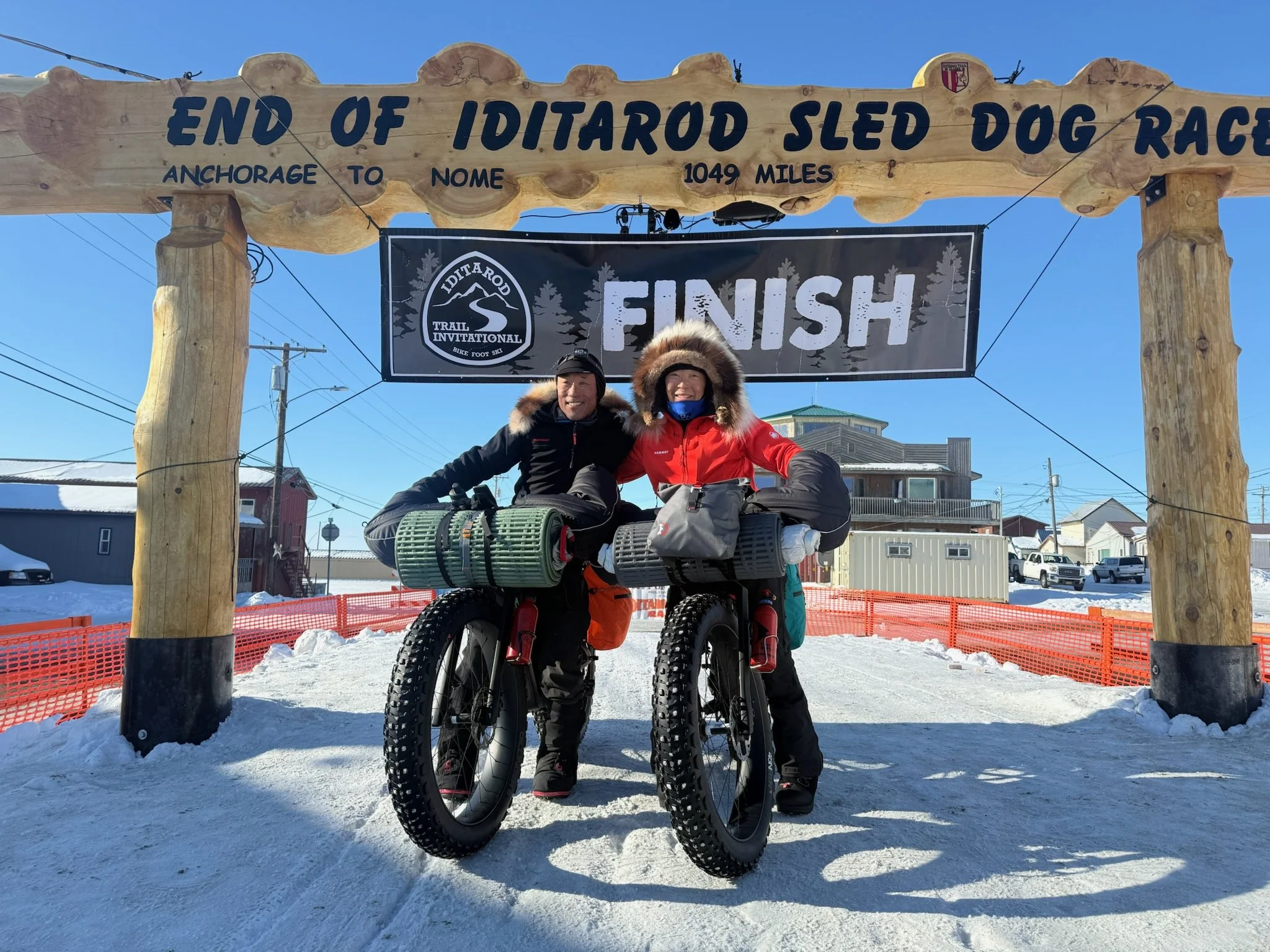
Kari (left) in her happy place and Petr, twinning leaving Shaktoolik. Photo thanks to Carol Seppilu, who passed it along from a local in Shaktoolik.

We are now down to four racers on the course, three on foot and one on skis. They are not lagging behind by any means; rather, they are right on schedule for an “average” finish time for those on foot or skis. This year the course conditions and weather favored faster bike times; in fact, in the last ten years, it is uncommon for all bikers to finish in under 22 days. 

Jon Richner and Erick Bassett traveled together all night from Little Mountain cabin to Koyuk, arriving in Koyuk at 6:15 this morning. The theme across Norton Sound so far has been a stiff North or Northeast wind and this trend continued overnight and will stay this way for the next several days. In Koyuk, folks stay at the school, get drop boxes, and often sleep in the school library/storage space. They may have access to a shower in the school locker room and can charge electronics. We heard there were pizza rolls in the freezer, supplied by a wonderful teacher - we wonder, did the bikers leave any behind? It’s these overnights in a warm school that can make a person feel a bit civilized before venturing back into the stark and challenging wilderness. These communities often feel centered around the school, and each one has a unique cultural feel and history that is often displayed in the entrance and hallways. After a fairly short rest, Jon and Erick are traveling again together, perhaps with the aim of Kwik River cabin before night. 

Last night heading into Shaktoolik, Kari Gibbons and Petr Inman got a taste of what Kari called “character-building” winds. After getting some rest at the school, they took off for Little Mountain safety cabin around 11am, with wind chills in the -30 to -35 deg F range. A local snapped a picture of their matching outfits - was it planned? Great minds dress alike, we say. The challenge with a wind like this is that there is no taking a break from it and it is right at their face, making eating and drinking a challenge. Racers need to protect their faces when they are getting buffeted by wind and wind-driven snow, and indeed, of course Kari and Petr are experienced racers, well-prepared with goggles, hoods, and face coverings. One of the biggest challenges often experienced in ITI versus other winter races is the high winds that racers may face. Expect to see Kari and Petr rest at the cabin for several hours and head for Koyuk overnight. Little Mountain safety cabin looks bright and cute from the outside, but it is…not the most hospitable place inside. Racers tend to think of it more as a bare-bones but much-needed shelter from the wind. No need to worry about the sea ice; all reports indicate it is safe and normal where the trail is marked. Long-time readers may remember that last year a big storm surged from the southwest later in the race, causing some break-up issues with the sea ice and resulting in seawater on top of the ice. That is not the case this year, as these north/northeast winds persist and this weather pattern holds. 

The Iditarod Dog Sled race is officially over, with 22 of the 33 teams finishing in Nome. This also means that much of the traffic on the Iditarod trail is now done as well. A few villagers may travel between villages here or there, but otherwise, the trail conditions will be determined by Mother Nature. 

Author: Faye Norby

Kyle DurandComment
All the Bikers Have Finished, Winds in Norton Bay, and Downhills That Slap!

Today we saw the final two bikers reach Nome!

Janice Tower (bike) - Finishing this afternoon was the second biker in the 1,000-mile race and likely the most decorated racer in this year’s race, and possibly ever. Janice is the OG. Her first ITI was in 2002. Prior to this year, she started the ITI 350 six times and finished four times. In addition to that she completed the Susitna 100 11 times, White Mountains 100 4 or 5 times, and the Arrowhead 135 once. Her motto is to “Dream big and dare to fail,” which is attributed to Norman Vaughan. He was tremendously influential in the world of polar exploration, mountaineering, and the Iditarod, completing the Iditarod Trail Sled Dog Race for the last time at the age of 84. She considers going over the Alaska Range to be the best feeling in the world, and this year she wanted to see what’s beyond McGrath. She recently became a grandmother, is 63 years young, and raced with her brother Matt (aged 66). Janice and Matt have raced to McGrath together, and she found it to be a joy to share this experience with him. They had hoped to cross under the burled arch in Nome together. …and then go fishing together this spring! Thanks for being an inspiration and showing us what is possible!

Matt Tanaka (bike) - Matt has completed the 350 twice prior. He didn’t set out with a goal time, but rather that he would simply “get there when he gets there.” His favorite food on the trail is pizza and his least favorites are those things that make him go barf and give him the dry heaves. Three things that he cannot live without on the trail are water, food, and sleep. Go figure. This is some simple advice for folks potentially interested in the ITI - Check it! Other words of wisdom from Matt - “Like life is a journey. You don’t know how it will go. But without putting your best foot forward and giving it your best you’ll never know. Never be afraid to simply try.

Over in the 53rd annual Iditarod Trail Sled Dog Race today, Anna Berington reached the finish line in Nome very early this morning, traveling 1,128 miles from Fairbanks to Nome. She completed her 13th Iditarod, and had her highest finishing place ever - 13th place. Lucky 13! Also early this morning Samantha LaLonde finished the Iditarod earning the honor of Rookie of the Year, awarded to the highest ranking rookie, coming in 15th place (NB: Sam’s partner is Tucker Costain, who won the men’s race on skis to McGrath this year)! This afternoon Wild Winter Woman Emily Ford completed the Iditarod in 18th place, also in her rookie year. Emily has only been running dog teams in Alaska since 2023, but prior to that she and her dog hiked the 1,200-mile Ice Age National Scenic Hiking Trail in Wisconsin. Her dream is to show that the outdoors is for everyone. No matter your background, you deserve to feel comfortable and successful in outdoor spaces. Emily, we are elated for you and for what you accomplished!

Tonight the party in Nome is at the Nome Recreation Center for the Iditarod 53 Finisher's Banquet. It’s the awards ceremony for the Iditarod and is a celebration of music and community, the mushers, dogs, sponsors, and everyone who loves the Iditarod and all that it represents. There are speeches from all of the mushers and race officials. Awards are presented, and there is an impressive buffet of food. Many of the ITI racers who finished in the past few days are there tonight, making memories that they will never forget.

Oh but let’s not forget, there are still athletes on the trail. At this point, only four racers remain in the ITI race: three on foot and one on skis. They are all on the coast. How cool is it to start at Knik Bar, across the street from the ocean, travel all the way across Alaska (which is a big state, in case you haven’t heard), across the Alaska Range, through the interior, along the Yukon River, Kaltag Portage, and then to emerge at the coast again?! As Beat Jegerlehner once said - “The coast will blow you away! … and not just because it’s windy.”

Jon Richner (foot) and Erick Basset (ski) - They left Shaktoolik this morning and headed north into wind chills of -20 to -30 deg F. They took a rest at Little Mountain shelter cabin around 6 pm this evening. It is forecasted to continue to be a cool and breezy evening, so I am sure that they are well bundled up for the crossing of Norton Bay to Koyuk in the moonlight.

Kari Gibbons and Petr Ineman (both on foot) - Kari and Petr have continued to travel together. Last night they had a pretty good headwind coming into Unalakleet, but were rewarded with a pizza party at Peace on Earth Pizza in Unalakleet, complete with pizza, salads, and NA beer. Today Kari is fueled by a Big Daddy cookie and pizza. Petr reports that he’s feeling good, everything is going according to plan, and that they are on schedule. Today involved some climbing, as well as top-notch sledding opportunities. Kari reported, "Girl, I have so many favorite sections, but I really absolutely love the blueberry hills, and that last one down slaps, what a wonderful ride, what a glorious day!"

What is next for the ITI racers? The forecast tomorrow in Shaktoolik calls for a cool morning, but sunny conditions and a high temperature of 9 degrees with a north wind of 10 to 15 mph. Certainly chilly and breezy conditions, but doable for our intrepid athletes!

Author: Leah Gruhn

Kyle DurandComment
Sibling Success on the ITI 1000 Trail

Congratulations to the incredible brother-and-sister duo, Matt Tanaka and Janice Tower, who completed the ITI 1000 today in 21 days, 1 hour, and 25 minutes.

Both athletes have demonstrated outstanding endurance and determination. For Janice, this marks her fifth ITI finish and her first successful journey all the way to Nome. Matt secured his fourth ITI finish, also celebrating his first arrival under the iconic Nome arch.

Their achievement is even more remarkable given that both siblings are in their 60s, proving that passion and perseverance defy age. Congratulations, Matt and Janice, on your inspiring accomplishment!

Kyle DurandComment
Julie Perilla Garcia: 2025 ITI 1000 Women's Bike Champion

Julie Perilla Garcia has triumphantly crossed the finish line in Nome, completing the challenging 1,000-mile journey in 20 days, 2 hours, and 5 minutes to earn the prestigious title of the 2025 ITI 1000 Women's Bike Champion. This remarkable feat marks Julie's third successful finish in the Iditarod Trail Invitational and, notably, her first completion of the entire route to Nome.

Julie's road to victory was marked by resilience and unwavering determination. In 2023, injury forced her to withdraw from the race, but rather than allowing this setback to define her, she returned in 2024 as a volunteer at the McGrath finish, providing crucial support and encouragement to fellow athletes. Fueled by this experience and her enduring passion for the event, Julie came back stronger and more determined in 2025, ultimately conquering the demanding Alaskan terrain and securing her place among ITI legends.

Congratulations to Julie on her extraordinary achievement!

Kyle DurandComment
Girl, You Would Not Believe the Night We Just Had

Have you wondered how these ITI updates got started? Leah Gruhn several years ago, started writing updates on women in the ITI and posted them to the Wild Winter Women (WWW) Facebook group. WWW was created to support and celebrate women in the winter ultra-endurance space and provide a community for these athletes to share knowledge, skills, and ideas to help others succeed. Leah asked for volunteers from the group to write them in 2023 while she participated in the ITI. We band of merry ITI nerds jumped at the opportunity and, if you couldn’t tell, we’ve been having fun with it, and here we are in 2025 still going strong.

On the northern coast of Norton Sound, racers awoke to cooling temperatures and moderate winds from the north, with area weather stations reporting temperatures ranging from -10 to 6 deg F above, and reported winds from 6 to 10 knots. These are some of the lightest winds we’ve observed recently and should allow for good riding conditions.

Biker Ryan Wanless is on the final approach into Nome; he stopped for several hours overnight at Topcock Cabin and should finish this afternoon. Ryan hails from South Dakota, and returned this year for his fourth finish in Nome. In 2022 he made the trip on foot, and every year since he’s preferred to ride. His love of this event shows in many kindnesses along the way. Perhaps as a racer you were thinking about scratching because of that terrible wind storm with deep snow drifts? Fear not, Ryan might just talk you into sticking it out. 

One of the things that draws Ryan back year after year is his love of interacting with the local communities. He is incredibly generous to the people he meets on the trail. He purchased locally made jewelry while in Nikolai, and that fry bread that finishers in Nome have been enjoying? Purchased by Ryan as a part of a local fundraiser. We don’t know exactly how much he’s sent out to the villages, likely more than the Wisconsin Badgers shirt, hat, and even a bike that he’s known to have gifted. Ryan approaches Nome with mixed emotions, he really enjoys his time on the trail and will be sad to leave it. That said, he is very excited to stop at the Safety Roadhouse, this is the first year he’s made it there early enough to find it open. If he stopped, he didn’t stay for long.

What’s that, roadhouses that aren’t always open? Safety Roadhouse gets its name because the trail between White Mountain and Nome can be dangerous, with cold air currents and known blowholes that can be very dangerous, a high ridge to cross before Topcock, and considerable potential for ground blizzards. These weather conditions can make following the trail difficult, and Safety provides a respite from these conditions. 

During the winter, the roadhouse is only open during the Iditarod sled dog race. Once the last musher passes, it closes for the season and ITI racers will find a shuttered building. This means that some bike, and all foot and ski racers typically don’t get to enjoy lunch or a hot drink at this cozy stop 22 miles before Nome. Traditionally, visitors write their name on a dollar bill and staple it to the wall.

Bikers Julie Garcia and Karl Booth are also expected to finish today, after a short stay at the Kuich cabin (local name) between White Mountain and Topcock that is not marked on Trackleaders. They are now both between Topcock and Safety.

Julie Garcia is back this year for the fourth time. She completed the 350 in 2015 and 2016, and returned in 2023 for her first bid for Nome. Due to a knee injury sustained early on, her race ended in the ghost town of Iditarod. In 2024 she volunteered at the 350 finish in McGrath, we’ve heard many anecdotes about how well she took care of racers. Julie came back in 2025 armed with strong knees and a fur ruff (much longed for during -40 weather in 2023). When she’s not competing in cold weather races, Julie is a self proclaimed nerd, AKA a software engineer that taught herself to code when she was six.

Karl Booth is from the UK and has been working towards the goal of riding to Nome for 10 years. This is his second ITI, having completed the 350 in 2023. Karl is well-liked by fellow racers for his friendly and easy-going style. He is so helpful that while in McGrath the volunteers couldn’t stop him from helping out with dish washing and cleanup! He and Julie have been traveling together since near the start. 

After a long visit in White Mountain with longtime ITI host Joanne Wassillie, Matt Tanaka and Janice Tower left at 10:00am, and are planning to finish on Sunday. Matt said in a social media post that he once told Joanne he’d ride there one day for a visit, and he’s finally made that promise come true. 

The foot and ski athletes are making their way through Unalakleet, runner Jon Richner presumably got his headlamp from Erick Basset (said headlamp was forgotten at an earlier checkpoint), who arrived in Unalakleet last night around 10:30 pm. Jon and Erick departed Peace on Earth this morning and are well on their way to Shaktoolik. 

We have an incredible story to share from runners Kari Gibbons and Petr Ineman, or to quote Kari herself “Girl, you would not believe the night we just had.” Kari and Petr arrived at the Old Woman cabin last night around 9:00 pm. Perhaps they were expecting to have the cabin to themselves but instead, they found a Norwegian group that was guiding a mushing trip, a massive operation. 

Perhaps fearing a crowded cabin, they were instead fed a hot pork and creamy rice dish, with Norwegian chocolate for dessert and even whiskey! After this luscious meal, they were put to bed in a private heated tent where they slept on a caribou hide. Seriously, a caribou hide! It’ll be hard to top that surreal experience, but they did manage to drag themselves away early this morning, and Kari was looking forward to an “easier” day on the trail. Tonight they’ll dine on pizza and if they’re lucky, even a salad. 

Weather forecast this morning in Unalakleet is mostly cloudy, currently 7 degrees with a high near 14, and southwest winds 5-10mph. 

Author: Amber Crawford

Kyle DurandComment
Arch unveiled as more racers make their way to Nome

Yesterday a new burled arch was unveiled at the finish line of the Iditarod Trail Invitational (ITI) and Iditarod Trail Sled Dog Race in Nome, Alaska. The old burled arch crumbled last spring after the sled dog race and ITI had ended. As per the Iditarod Trail Committee, “The City of Nome and Iditarod invited Iditarod veteran Ramey Smyth, who constructs log homes, to create a new burled arch. 

“Ramey and his family were a perfect fit for the project, since his mother, Lolly Medley, finished the race as the second woman ever to cross the finish line in 1974, before the first burled arch was erected. Since that time the Smyth’s including, mother Lolly, father Bud Smyth, brother Cim, Ramey, and his wife Becca Moore have been a part of 51 Iditarod runs.” 

Wild Winter Woman Becca Moore has raced the ITI twice on bike, as well as twice in the Iditarod Trail Sled Dog Race. The work of Ramey, Becca, and the rest of the team is a tremendous contribution to the events and the City of Nome. It is be an honor to stand under the new arch after a 1,000-mile journey by bike, foot, ski, or dog team.

Due to trail conditions, the start of the Iditarod Trail Sled Dog Race was moved to Fairbanks only 10 days before the start of the race. Despite the route change, the sled dog race still shared the trail with the second half of the ITI route. Many of 1,000 mile ITI racers had the opportunity to interact with Iditarod mushers, volunteers, and fans. Typically those interactions are a highlight - to share stories about the trail, see the beautiful dogs running or resting, and bring energy to the otherwise lonely trail.

This morning around 3 AM, Jessie Holmes, the winner of 53rd annual Iditarod Trail Sled Dog Race, reached the finish line in Nome. He and his loyal and hard-working team of dogs were on the trail for over 10 days, traveling 1,128 miles from Fairbanks to Nome. Since then a number of other mushers have finished the race, including fan favorites Paige Drobny (third place overall and first woman) and Michelle Phillips (fourth place overall and second woman).

Only nine racers remain in the ITI race: five on bike, three on foot, and one on skis. 

Ryan Wanless (bike) - Ryan’s competitive side is coming out as he makes a push for the finish line. He rode last night until 8:30 pm and overnighted at the town of Golovin. At the Golovin school, Frank and Audra typically take racers in for a meal and offer a place to stay for the night. This morning Ryan got rolling just before 9 am, right before sunrise. He stopped in White Mountain for a late lunch, was spotted on the Iditarod live feed from the White Mountain checkpoint, and is on his way to the Topkok cabin for the night.

Julie Perilla Garcia and Karl Booth (both on bike) - these rookies have been traveling together the entire race. They started their day at Walla Walla safety cabin, got an early start at 4:15 am, and made great time going over Little McKinley, which is nearly the last significant climb in the race. They appear to have enjoyed a ripping downhill, stopped in Golovin for brunch at the school, stopped in White Mountain for dinner, and are on their way under a full moon to the cabin in the Topkok hills for the night. Julie and Karl have been about 10-15 miles ahead of Janice and Matt for much of the day.

Janice Tower and Matt Tanaka (both on bike) - Janice and Matt are also both rookies who have been traveling together the entire race. This morning they started riding from Elim school at 7:30 am and rode on sea ice to Little McKinley. They, too, made great time going over Little McKinley and on the ice in Golovnin Bay. They stopped for a meal in Golovin and  were spotted on the Iditarod live feed from the White Mountain checkpoint on their way into town for dinner.

Jon Richner (foot) - After a late night into Unalakleet, Jon took a rest day today while he waits for Erick to bring him his headlamp, accidentally left charging in Kaltag. Evidently a musher kindly lent him one to get him through the Kaltag portage, which is the 77-mile long link between the Yukon River and the coast, from Kaltag to Unalakleet. Smart move to wait at a place with abundant pizza! We expect to see him moving again tomorrow morning. At this point, all of the dog teams have run past Unalakleet, so our foot and ski athletes are not expecting to see any more dog teams or active sled dog race checkpoints. The trail will return to the silence that is present the other 362 days out of the year.

Erick Basset (ski) - Erick left Old Woman cabin at 10:30 this morning and has been moving steadily all day. At this rate, it’s likely that he will ski to Unalakleet and stay there with Jon for the night.

Kari Gibbons and Petr Ineman (both on foot) - Kari and Petr have been traveling together until about 5 pm, but recently Kari has gone ahead. They started at Kaltag this morning at 5:20 am to traverse the Kaltag portage. There are two beautiful log safety cabins along the portage where racers can stop for warmth and rest. The two safety cabins are known as Tripod Flats and Old Woman. Kari sent a message from the high point on the Kaltag portage and said, "Well this sure is freakin’ pretty!" They are headed towards Old Woman cabin and may stay there overnight.

What is next for the racers? Bikers might finish in three distinct groups on Saturday, as long as things go smoothly. Forecasted winds along the coast look breezy in places, but doable. The walkers and skier will be at it for more days to come. We are wishing for favorable conditions that will give all nine of them safe passage to that beautiful burled arch in Nome!

Author: Leah Gruhn

Kyle DurandComment
Four Athletes Complete the ITI 1000: A Testament to Endurance and Grit

Today, four incredible athletes crossed the finish line of the ITI 1000, each completing their journey through Alaska’s remote and punishing terrain in their own way. Each arrival at the finish line told a different story—one of personal triumph, of overcoming obstacles, of resilience in the face of exhaustion.

Congratulations to today’s finishers—you’ve earned every step of this journey!

Troy Szczurkowski (left) and Perry Jewett (right) finish the ITI 1000 in 17 days, 23 hours and 2 minutes.

Matt Garretson finishes the ITI 1000 in 17 days, 23 hours and 41 minutes.

Thomas Miller finishes in 18 days, 5 hours and 12 minutes.

Kyle DurandComment
Total Eclipse of the Trail

It was another event filled day on the trail with bikers Troy Szczurkowski, Perry Jewett and Matt Garretson all arriving in Nome, and Thomas Miller finishing soon. They all left Topcock this morning in temperatures slightly above zero with a heck of a wind chill. A nearby weather station reported sustained winds of 28mph, gusting to 33mph.  

Perry and Troy finished together at approximately 2:00pm; and Matt followed closely behind at around 2:40pm. They were able to finish under the newly revealed burled arch at the  Nome finish line, which is now prepped and ready for the first musher to come in, expected early tomorrow morning. Thomas finished at approximately 7:10pm. 

A few fun facts about today’s finishers; Troy volunteers to help teach the ITI winter training camp every year right before the race, considering it time to acclimate to cooler temperatures than his native Australia, and enjoys sharing his copious experience on the trail. Perry has directed 54 races during his volunteer race director career, and has dreamt of getting to Nome for 15 years. Congratulations, Perry, on making that dream come true! Matt brought his family to Alaska this year so they could all see the start for his third trip on the ITI and first time to Nome. Thomas’s nickname is Thomas the Tank, he’s not fast, but nothing can stop him.

Biker Ryan Wanless is approaching Mt McKinley cabin and reported good trail overnight from Koyuk to Elim. He stopped at Walla Walla cabin during the day to rest, and plans to push on to Golovin today where he’ll enjoy a delicious meal provided by locals and sleep in the school.

Bikers Janice Tower and Matt Tanaka spent last night at the Kwik River cabin about 21 miles from Koyuk. Fun fact? Apparently this cabin always has a slippery entrance, confirmed by Faye Norby!

Bikers Julie Garcia and Karl Booth rested in Koyuk for around 30 hours, hopefully enjoying the hospitality and pizza rolls after a brutal headwind-filled crossing of the sea ice. They left Koyuk early this morning and are now resting in Elim.

Back with the runners and skiers, runner Jon Richner spent last night at Old Woman cabin on the Kaltag Portage. Jon is mixed in among the back half of the dog sled race, and if he’s lucky he’ll have been gifted a tasty snack or two from a musher. Skier Erick Basset left Kaltag this morning and is also on the portage, currently at Tripod Flats cabin but hasn’t been there long, it’s unclear whether he’ll continue on tonight or take a break. 

Runners Kari Gibbons and Petr Inman are in Kaltag, perhaps feeling a sense of relief to be done with their long journey on the Yukon River. Kari arrived about two hours ahead of Petr, and had been traveling just a few hours ahead of him for most of the race. Kari has reported several nights in a row of northern lights and a giant, wispy moon, no headlamp required! 

Fun astronomy fact, the full moon is overnight tonight and there will be a total lunar eclipse. Totality phase timing is 10:26 p.m. to 11:31 p.m. AKDT on Thursday, March 13, 2025. One can’t help but wonder how many athletes will be out to see it when rest is so badly needed at this point in their journey.

Unfortunately Magdalena Paschke scratched yesterday after a family emergency called her back to Germany. She has had a string of bad luck with the race to Nome, in 2023 she scratched due to frostbite after an extremely cold night caused many racers to pull out, and in 2024 she was forced to stop by illness. We wish her safe travels home and hope to see her again next year!

Author: Amber Crawford

Kyle DurandComment
Cheers to the Magnificent Seven!

This morning, twenty-one 1,000 milers remained on the journey to Nome, split into four main groups from Galena to Nome.  The strong lead pack of men in the 1,000 bike division, ITI 2025’s “magnificent seven,” awoke with merely 54 miles to go to reach the burled arch in Nome. They have been traveling together the past 2-3 days and spent their last (likely cozy) night together in a new cabin that is not marked on Trackleaders, in the Topkok hills. This group has been seeing firm, fast conditions in the morning and softer (sometimes pushing) conditions in the afternoons as the now mid-March sun softens the snow, regardless of wind or air temps. They left the Topkok hills cabin around sunrise this morning and have been moving together in a tight group through the Topkok hills, past Safety Sound, moving efficiently through the blowhole remaining unscathed, and eventually riding fast (clocking speeds over 12 mph) on the Nome road to finally reach the brand new burled arch, built by musher Ramey Smith, whose wife Becca Moore is an ITI 350 bike veteran. The magnificent seven finished well ahead of the lead musher (last reported in Golovnin), with a strong finish time of 17 days, 2 hours, and 38 minutes.

To the seven of you, our sincerest congratulations. You are all true champions! Enjoy your victory lap on the long road into Nome and bottle up these feelings of accomplishment to remember later. You have much to be proud of, and we can’t wait to hear the rest of the stories from the trail.  But first, for the faithful dot watchers, let’s uncover a bit about who our champions are on and off the trail.

Roberto “Robi” Gazzioli: Robi a friend and a colleague who works with the Mulonia brothers (more on them next), guiding bike trips. He gave a tongue-in-cheek sponsorship shoutout to his friend, as he is actually riding one of Willy’s bikes on this journey. Robi has completed the 350 on foot three times, and has ridden twice all the way to Nome in 2022 & 2023, with a third ride that ended in Unalakleet prior.  ITI was Robi’s very first winter ultra in 2008, he purchased a down sleeping bag and jacket in Alaska that year before starting the race and he is still using them on this race 17 years later. There were no qualifying events at that time, and Robi believes the fact that he hailed from Brescia– a community in northern Italy with a good tradition of ITI participants–  might have helped his initial odds of acceptance into the event. Robi bike commutes 20k to and from work every day as his training, and uses this as a mental boost when he is within the last 20k of a goal or checkpoint, “It’s just a ride home.”  

Tiziano Mulonia: Tiziano Mulonia hails from Chiari, Italy, just west of Brescia. He is known as the group navigator and weatherman, always informing the group how much further to the next checkpoint or safety cabin and what the weather will be tomorrow. He was a late bloomer when it came to cycling, with his older brother Willy’s influence finally rubbing off on him. But once he started cycling, the ITI became his obsession. This is his sixth consecutive ITI, racing the 350-miler in 2020 and 2021, and the 1,000-miler every year since 2022. Every winter he comes to the U.S. from Italy a month or more in advance of the ITI to train and acclimate to the cold conditions. 

Willy Mulonia, aka “Zio WIlly” or Uncle Willy: This year will mark Willy’s 8th ITI finish and his 4th attempt to Nome. His first run was in 1999. In 2000, WIlly experienced a serious and life threatening accident in the Alaska Range, but it didn’t stop him from going after his dream of the 1,000. A great recent USBC substack article by Hard Yaka includes this great quote from Willy summing up what he learned from the experience: “Over all these years, I came to understand that Alaska is not a dangerous place. I’m what’s dangerous in Alaska—if I don’t know what I’m doing. Because if you know the circumstances, if you know how to move with the people, if you know what your expectation is for help—and my expectation is zero—then everything you receive is like a gift. The most dangerous thing in Alaska is me.” Read the Full article here. When Willy is not racing the ITI, he works as the Founder & President of PA Cycling (https://pa-cycling.cc/), running adventure cycling trips around the world from his home base in Spain. 

As one of the most experienced riders in ITI this year, one wonders what might bring a person back year after year.  Willy shared that what motivates him is knowing “life is like a book of blank pages on which we write our story, well… then I am the pencil I use to write, and the ITI is a sharpener. With time and writing, all pencils get dull, making it harder to write clearly. The ITI helps me stay sharp and always become a little better.”  He shared in his pre-race survey that the three things he could not live without on the trail are the snow, Robi, and his brother Tiziano. With that said, we are glad he made it through the snow-less tussocks, and hopefully was able to enjoy some of his favorite trail snack to help him through the snow-less lows: Parmigiano Reggiano with embark, “like a cheesecake.”

Leah Gruhn shared many miles in the 2023 ITI 1,000-mile race with Robi, Tiziano, and WIlly in 2023 and describes them as “industrious, hard working, welcoming, fun-loving, and top-notch travel companions.” 

Peter Delemere: Peter is an expert in space physics at the University of Alaska Fairbanks Geophysical Institute. While his companions on the trail may have enjoyed the magic and beauty of the aurora this year, Peter most likely saw them as particles, energy, magnetic fields, and material blasted into the solar system by a solar storm. Science writer with the Geophysical Institute at the University of Alaska Fairbanks, Ned Rozell, wrote a great piece on him in 2024, describing how in his 2024 ride to McGrath, all Peter Delamere could think about was the dichotomy paradox, a concept Aristotle included in his work “Physics.” Forward motion is an illusion because halving the distance to your goal is a never-ending process. “I crawled across the landscape, inching closer and closer to McGrath, but with the finish seemingly out of reach,” Delamere wrote in a summary of his race experience.  Today he will continue to bear the heavy mental burden of the “dichotomy paradox” until he is safely under the arch at a remaining distance value of “zero.”

Casey Fagerquist: Casey calls Anchorage home though he grew up in Casper, Wyoming. He moved to Alaska to attend college (he was a collegiate Nordic Ski racer) and like so many others he never left. Casey had aspirations of going to the Olympics, but got “distracted” by all of the incredible outdoor adventures Alaska had to offer. Nordic-ski racing definitely acquaints a person with the depths of the pain cave early in life, so Casey is well-equipped for the suffering of winter ultra endurance events. He doesn’t subscribe to a lot of gym time or ‘that wattage stuff,’ his MO is to get out and ride outside no matter how bad the weather, and this certainly serves him in the Alaskan backcountry. Casey has completed both the 350 and the ride to Nome multiple times before, (including one race while he had the flu), and he went to Nome in 2020, a year when only three finishers made it. He also had the wild experience of exiting the wilderness bubble only to find North America completely shut-down due to the COVID-19 pandemic.

Joshua Brown: Is he about to earn the first ever ITI 1,000 Triple Crown?!  Nome isn't new territory for Josh. He previously completed the foot division race in 2022, and upon finishing in 2024, became just the third person ever to complete the 1000-mile ski division in ITI history. He's the first competitor to finish both the 1000-mile foot and ski divisions—despite having minimal cross-country skiing experience until a few years ago, and will become first racer in history to complete a triple threat (completing the race via bike, foot, and ski in different years). Josh had us chuckling along the way this year as he commented to volunteers in Nikolai he did not intend to be toward the front as he is “not much of a biker.” This is clearly a pattern, because as a skiing novice just a few years ago, he said much of the same before becoming one of the first skiers ever to finish the 1,000-mile race. To prepare for his 2024 ski attempt, Josh researched nordic skiing and devoted himself to training, skiing several hours before work and practicing with Alaska Pacific University's highly ranked nordic ski team during the evenings. When not on skis, he tested various equipment and even crafted custom gear from basic materials.  As previously suggested, finishing the ITI 1,000 once transcends physical and mental achievement. Finishing it three times in three different modalities is beyond next-level.  

Josh, known for his unwavering persistence and strong work ethic, serves as an active-duty Lieutenant Colonel at Joint Base Elmendorf-Richardson, and works as a medical advisor for the Air Force's Arctic Warrior program. He is uniquely qualified for the race to Nome, as it turns out, as his vocational role involves developing innovative approaches and equipment, and enabling military operations in extreme cold conditions, and the ability to adapt and endure through difficult circumstances represents one of his greatest strengths. He resides in Eagle River with his spouse and three children, where they frequently spend free time exploring Alaska's natural environments.

Josh's ITI involvement extends beyond just competing. In 2023, rather than racing in the ITI, he prioritized giving back to the community by managing the Nikolai checkpoint for nine days alongside Jon Richner (the current lead foot racer en route  to Nome this year).  The two of them share more than 20 years of friendship.  

Cptn Mike Beiergrohslein: Mike is an ITI veteran who has been to Nome once before in 2016 (and swiftly, in 17D:7hr:47 min– shoutout to Mike’s mom for the quick stat!) and Mike has also ridden to McGrath a number of times. He is married to Alycia, and they have three children who all love biking, skiing, and other outdoor adventures. According to Alycia, Mike is not overly concerned about “his finish time” on the trail, as he enjoys time in checkpoints, meeting people, and good conversations, and good rest.  Fellow racer Jill Homer shared some miles with Mike on her ride to Nome in 2016, and describes him as “good-humored and positive” as a traveling companion. She recalled one story where they encountered the Happy River, wide open and flowing fast above Puntilla Lake. Mike came upon another racer, Robert Ostrom, who had nothing waterproof to pull over his boots. So Mike put on his waders and carried his own bike across, then ferried Robert’s bike across, then returned a third time to collect Robert (a normal sized man), who rode across on his shoulders. Jill remarked that the current was strong enough to push them downstream with any slip, but for Mike it was all in good fun. His wife, Alycia said “This is the way he likes to take a vacation, challenging himself and enjoying Alaska.” Mike is in the public health service commission corp, and practices pharmacy in the Anchorage area. An avid hunter and outdoorsman, Mike reported in a recent Bikepacker article that one prized item in his 2025 kit is his humanely harvested Alaska-raised moose & salmon jerky for the trail.  We hope Mike enjoyed this year’s “vacation” very much.

Again, our warmest congratulations to you all, it has been a true pleasure watching your dots.

Getting accurate weather details for our racers has been both an art and a science. Weather in Nome may vary from the weather at Safety Sound, just as weather in Shaktoolik can be quite different from the weather further out on the sea ice. Even the weather in White Mountain tends to be calmer than the weather just downtrail in the Topkok hills. As far as we know, this morning’s temps ranged from 0F in Koyuk to 5F in Nome for our lead bikers. According to the Johnson’s camp weather station near the Solomon blowhole, winds were gusting over 30 mph last night, but dropped throughout the day today to the teens. While the blowhole appeared to cooperate for our lead riders, we know it is not to be trifled with, and that others may contend with different conditions in the days to come.  One cautionary bit of ITI lore is that in the 2018 race, three bikers (Jay Cable, Phil Hofsetter, and Kevin Breitenbach) moving through the blowhole came upon two hypothermic mushers (Janssen and Lanier) huddled together. They had been pinned by 50 mph subzero wind gusts and were certain they would have died, if not for the bikers who were able to activate an SOS signal to call for rescue.

Behind the lead pack, our second group of bikers, Perry Jewett, Matt Garretson, and Troy Szczurkowski are making their way across Golovnin Bay this afternoon during a fair weather window.  They will likely stay in White Mountain or the Topkok hills cabin this evening.

Behind them, the third group of five bikers, made up of Janice Tower and Matt Tanaka (Team tanaka) and also Julie Perilla Garcia and her friend Karl Booth, plus Ryan Wanless, appear to be enjoying a well earned layover day in Koyuk.  Yesterday was likely only slightly better than a stick in the eye, as this group of five crawled across Norton Sound for an 11 hour slog into a strong headwind and blowing snow.  They pushed their bikes for most of it, riding only a bit of it until finally reaching Koyuk around 10 PM.  They have all been taking a well earned rest today, still tucked into their sleeping bags past noon.

Lead foot athlete Jon Richner and lone skier Erick Basset are in the Kaltag area.  Behind them, the lead women’s foot athlete Kari Gibbons is in Nulato, with Petr Ineman just a few miles out.  Kari was looking especially strong today.  She left Nulato yesterday afternoon and moved for about 11 hours before bivying at the large bow in the Yukon for 6-7 hours, and then she set out again early this morning for Nulato finally turning south with her wind at her back which had to have been a reprieve. She appears to be moving well with her new cookies from Galena and her ramen breaks. Magdalena Paschke continues at the same cadence, just 8-10 hours behind Kari. We received a fun photo of Magdalena from Christof Teuscher last night and she appears to be all smiles on the Yukon

The moon is full tonight and will be visible now in the clear skies over Nome, a glowing reminder that we are just a little over 2 full weeks into this event which began with a new moon and will not end until the moon is nearly new again. 14 intrepid 1,000 milers remain on the trail tonight, and we will continue to bring you updates until the last one has completed their journey to Nome.  

Author: Allison Carolan

Wild Winter WomenComment
Seven Athletes Finish the ITI 1000 Together in Nome

After an extraordinary journey across 1,000 miles of Alaska’s rugged and unpredictable terrain, seven cyclists arrived in Nome this afternoon to complete the Iditarod Trail Invitational 1000 together in 17 days, 2 hours, and 38 minutes. Their arrival marks the culmination of more than two weeks of endurance, perseverance, and grit and a powerful testament to the spirit of camaraderie that defines the ITI 1000.

The 2025 ITI 1000 Co-Finishers are:

  • Josh Brown – Making history as the first-ever ITI 1000 Triple Threat inductee, completing the race in all three disciplines: bike, foot, and ski.

  • Tiziano Mulonia – Completing his fourth ITI 1000 and an impressive sixth consecutive ITI finish.

  • Willy Mulonia – Marking his third ITI 1000 finish.

  • Roberto Gazzoli – Completing his third ITI 1000.

  • Casey Fagerquist – Securing his second ITI 1000 finish, and notably, the second time he has crossed the finish line in the lead group.

  • Mike Beiergrohslein – Completing his second ITI 1000.

  • Peter Delamere – Achieving his first-ever ITI 1000 finish.

Rather than racing to Nome as competitors, these athletes chose to finish side by side, a reminder that while the ITI 1000 is one of the world’s toughest endurance events, it is also a journey of shared struggles, triumphs, and resilience.

Congratulations to all seven finishers on this incredible achievement!

Kyle DurandComment
The Halfway Doldrums and Finish Line Fever

Norton Sound, photo by Leah Gruhn, 2024

And then there were 21. 

Twenty-one athletes remain on a lengthy stretch of the Iditarod Trail between White Mountain and Galena. As more and more athletes approach Norton Sound, they have faced perhaps the most climactic stage of the race: the dodgy sea ice crossing to Koyuk, followed by more crossings and challenging coastal conditions. After hundreds of miles through Alaska's Interior, the burled arch finally feels within reach for some, creating mounting excitement for both athletes and dot-watchers as the lead bikers head into White Mountain this afternoon. The question hangs in the air: Will the lead bikers outpace the lead mushers to become the first racers to pass under the new burled arch? More on the lead men's bikers at the end…

Early this morning, Julie Perilla Garcia—holding second position in the women's bike category—and Karl Booth departed Shaktoolik behind Ryan Wanless. They pushed toward Little Mountain. Team Tanaka was resting at Little Mountain when Julie, Karl, and Ryan rolled in around 6 AM (quick PSA: trackleaders appears to have not updated their clocks with daylight savings). According to Emily Wanless, Ryan had planned this early morning push to take advantage of firm trails. However, upon arriving at Little Mountain, he found the wind had picked up considerably and decided to wait, choosing to make the Norton Sound sea ice crossing in proper daylight. Though trail breakers did come through yesterday, the trail on the ice has since blown in under the harsh conditions.

Team Tanaka was first to set forth across the ice from Little Mountain around 7:30 AM. Julie, Karl, and Ryan followed behind within the hour. While the morning winds over Norton Bay appeared moderate at 10-15 MPH, forecasts predicted a slight increase this afternoon and by 2 PM the bikers appeared to be moving straight into a 20 mph headwind. Progress has thus been slow today for these five, moving at mostly walking/pushing speeds for the past six hours and still just over halfway across the sound to Koyuk. Tonight's rest will be well-earned indeed.

Ahead of them, the middle pack of bikers (Matt, Perry, Thomas, and Troy) are moving through the slow-going section from Koyuk to Elim, but they appear to be getting it done.

For the foot athletes some 250 miles back, reaching Ruby recently may have represented a milestone. This "halfway point" of the 1,000-mile race marks the beginning of the Yukon River section, offering fewer climbs and more frequent villages to benchmark one's progress.

What does being 500 miles into a race and "halfway there" truly feel like? The answer varies by athlete, conditions, and likely how recently they've eaten a snack. Beyond checkpoint efficiency and the importance of rest, athletes must maintain self-discipline to address any new problems immediately rather than waiting for checkpoints—changing socks regularly and applying barrier creams to protect skin, for example. This becomes increasingly challenging during difficult weather conditions and as fatigue and sleep debt accumulate.

Mental approaches probably vary dramatically at this stage for foot/ski athletes. Some racers may gain momentum from crossing the halfway threshold. Though probably rare among ITI 1,000 participants, any true pessimists in the field might shudder at the thought of repeating the distance of the last two tough weeks all over again. We glimpse potential mental states only through the actions of their dots—strategic rest breaks, careful pacing, and check-ins back home about any nagging issues—all signs of athletes preparing for the next push while practicing crucial self-preservation.

Our 2024 Veterans report varied mental states around this halfway mark. In 2024, 1,000 bike veteran Leah Gruhn used Galena for a full rest day to reset, recognizing her need to conserve strength: "I was bagged and I had to say goodbye to my friends who I had been seeing each night. I really needed the rest and felt like it was WAY too early to dig myself into a deep hole." 1,000 ski champion Sunny Stroer remembers feeling very tempered, finding little significance in the halfway milestone: "It didn't feel monumental, since there were still 450 miles to go. The first time I really started thinking about overall mileage vs. the day-to-day was once I had made it across Norton Sound."  Faye Norby, 1,000 mile veteran, shared “Around Ruby, Galena, and Nulato, I was still so very tired every day but my body was getting used to ‘the going.’ It felt like the race was getting more manageable. I had little niggles, but they would only last for a few hours or maybe a day, so I knew I was getting stronger.” One thing is for sure: this stage of the race may feel more like an expedition than a race, as racers  settle into the “new normal” of just another long day on the trail.

Getting back to 2025: Our very own wild winter woman Kari Gibbons reached Galena last night after an impressive 18-hour push from Ruby, maintaining her unwavering steady pace. Unfortunately, her supply box had not arrived in Ruby, but she did have one waiting in Galena so this was a very happy stop for her. She now has a big box of what she called "Big Daddy Cookies" to send her down the trail. She is still adapting to the daily load on her body but is moving well and being efficient in checkpoints. Her mom, Rhende, says Kari got a full eight hours of sleep at Larry's in Galena, plus multiple plates of lasagna, an omelet, and the best care.

After a nice long rest stop in Galena, Kari departed again about two hours after Magdalena Paschke's arrival at the B&B. One hopes Magdalena came in ready for breakfast and that they shared a well-deserved juice box party of their own! Magdalena has consistently followed 8-12 hours behind Kari since McGrath, maintaining an equally steady rhythm of rest and movement. Petr Ineman has positioned himself consistently between Kari and Magdalena, also maintaining steady progress since McGrath. Only Jon Richner remains ahead of Kari, Petr, and Magdalena in the foot field, while lone skier Erick Basset continues to hold his position between Kari and Jon.

Meanwhile, the magnificent seven lead bikers (Roberto, Peter, Tiziano, Mike, Josh, Willy and Casey) face an entirely different mental landscape now, after crossing both Norton Sound and Golovnin Bay and pushing inland to White Mountain this evening. They have less than 100 miles to go to complete this epic journey. They may feel focused on finishing and maybe even a little impatience. Some might even be fighting the urge to make the final push without resting long as "finish line fever" sets in.

But no matter how intense the longing for a finish may feel tonight, they must remain focused on the tasks at hand —rest, fueling their tired bodies, and one more night of menial chores and disciplined self-care. Though they are so close, and the forecast is looking favorable, the remaining challenges—the Topkok hills, the notorious blowhole near Safety Sound, and unpredictable coastal conditions—are not to be taken lightly tomorrow.


Kyle DurandComment
100 Years of History at Mile 550

Author: Faye Norby

There is now a lead pack of 7 bikers who left Koyuk this morning and are on their way to Elim. On this section, they travel on and along the sea ice for around 10 miles, then they have one medium-size overland climb before they drop back down to the Kwik River inlet. From there, they go across the inlet and by the old radar station before having one last climb before Elim. Then it is a fun downhill into town, where they will be welcomed at the school. It is spring break for most Alaska school districts this week, meaning the schools are empty during the day, with plenty of room for our racers. Some schools will have open gym in the evening, where the kids come in to run around. In these village schools, racers often stay in the gym, a home-ec room, or a combination library/storage space type of room. 

The rest of the bikers have eaten their fill of Peace on Earth pizza and are on the move. A group of 4 are traveling across Norton Sound and appear to be moving ok at times and slow at other times. Janice Tower and Matt Tanaka left Shaktoolik this afternoon and will likely stop at Little Mountain Cabin tonight. Julie Perilla Garcia, Karl Booth and Ryan Wanless are currently in Shaktoolik. Roberto Gazzoli reported that, as of last night, the trail is marked across Norton Bay with tree branches and sticks stuck in the ice. The Iditarod Trail Crew trailbreakers will officially mark it with reflective stakes when they go through. We are unsure where the Iditarod trailbreaking crews are currently. They were holding in Unalakleet and typically will stay at least a day ahead of the first dog team. It is rumored they are now in Shaktoolik, so if they didn’t mark the bay crossing today, it is likely they will mark it tomorrow. The dog race has slowed considerably in the last few days as the dog teams are all south of Kaltag on the Yukon River right now in soft, new snow and windy conditions. Estimates are the first dog teams will arrive in Nome either Thursday or maybe even Friday depending on conditions. This means the race is ON between the bikers and the dog teams to be first to Nome! Our money is on our first pack of bikers to be the first to finish under the brand new Iditarod Arch currently being assembled on Front Street. 

Winds continue from the Northeast, but do not appear more than 20mph throughout the sections our racers are in. Temps are mild with a few light snow showers here or there. Many of these sections are prone to drifted trails, so trail condition depends on how much snow has fallen and what the wind speeds are. 

At one point this morning, the foot racers were all within 50 miles of one another, and now are all on the Yukon River. Unfortunately, Gavan Hennigan posted tonight that he has made the difficult decision to drop due cellulitis. This is a non-contagious bacterial infection and not something to take lightly, so we wish Gavan all the best. In the meantime, Jon Richner has taken the lead and left Galena around 8am. Kari Gibbons and Petr Ineman left Ruby during the night/early morning, and Magdalena Paschke left before noon. It appears that Daniel Heon scratched today in Ruby. Skier Erick Bassett arrived in Galena this afternoon. 

When our athletes arrive in Galena, they cut across the Yukon from where the trail is to the opposite bank where the town is. The Yukon is very wide here, it can take our foot athletes an hour or more to cross. They climb the river bank and head north on one of the main streets (Antoski Road) in this village. Along the way, they get a good tour of the town, going past a well-stocked store, the Edgar Nollner Health Center, the Galena pool (fun fact: this is the only pool on the entire Yukon River), the school, and eventually they arrive at Alexander’s Lake B&B, hosted by owner Larry Haussmann. Many a midwestern athlete has remarked on how much this house feels like “home” and indeed, Larry was born and raised in North Dakota, and has likely brought his midwest culture and style, even though he has lived in Alaska for over 50 years. Larry is a former kindergarten teacher, so is well-equipped to handle our athlete’s every need at mile 550 of the race. He makes sure to feed them big balanced meals, complete with fruits and vegetables, but he also gives them fun surprises like juice boxes and sodas. Larry is a natural story-teller and it can be quite difficult to leave his table, his comfy recliners, and his fascinating stories to head back out on the trail. There’s something else you should know about what’s in Larry’s house. Near his stairs is a picture of a spry, fit-looking elderly man next to a woodpile, clearly still capable of chopping wood at his age. This man is Edgar Nollner Sr., Larry’s father-in-law. 

As you may know, 2025 marks the 100-year Anniversary of the historical Serum Run, where 20 mushers and about 150 sled dogs carried the diphtheria antitoxin from Nenana to Nome in five and a half days to stop the spread of the deadly disease, saving the Village of Nome. Edgar Nollner Sr. was one of the mushers to carry the serum, delivering it from Whisky Creek to Galena. Not only did Edgar participate in this life-saving act (on both serum runs; another happened a few weeks later), he also saved the lives of two Air Force pilots who crashed near Galena. Additionally, Larry tells of several winters in which Edgar used his moose hunting skills to help feed the village during tough times. Edgar never smoked or drank in his life and the Galena Health Center is named in his honor. Edgar outlived all the other serum run mushers, dying in 1998 at the age of 94, still chopping wood into his 90’s. 

In a fun cross-over, the Robinson family, consisting of Wally, Emily (4-time Junior Iditarod champion), and Stanley are currently running a team of their dogs along the Serum route. They started from their home near Fairbanks and are heading to Nome. The ITI trail roughly follows the old serum route from Ruby to Nome. The Robinsons are currently in Kaltag and are taking their time, using this as a training run for their younger pups. When they were in Galena, they stopped in at Larry’s house and did an interview (link below), from that comfy living room our athletes have to leave. 

Although much has changed in the last 100 years (comfy chairs, juice boxes, etc.) for the most part, the trail remains much the same, connecting village-to-village and person-to-person. 

If you are interested in learning more, here are some links:

The Iditarod Dog Sled race is publishing a series on the Serum Run: https://iditarod.com/category/alaskan-history/?fbclid=IwZXh0bgNhZW0CMTAAAR0xw2rvX0XdI5L0hCLP3a1a5OJQz6VkS8dWp1v61poanwx1DqA059YJUmU_aem_DCluz25qt3gVEPb3LBy30A

More about Edgar Nollnar Sr.  https://jukebox.uaf.edu/sites/default/files/Edgar%20Nollner%27s%20Biography.pdf

Robinson family updates: https://www.facebook.com/profile.php?id=100063681832738

Emily’s interview with Larry in Galena: https://www.facebook.com/share/v/15wYtchZqA/

Wild Winter WomenComment
Peace on Earth (and Wind)

The trail is getting even more interesting for athletes as they experience disagreeable weather and grumpy, overtaxed bodies start to break down. Leaders have now passed through Unalakleet, home of much-beloved Peace on Earth Pizza; more on that later.

At the front of the pack yesterday, bike leaders Casey Fagerquist, Joshua Brown, and Peter Delamere stayed quite a long time in Shaktoolik and, in the early afternoon, took a brief foray north towards Norton Bay before turning around and heading back to Shaktoolik. They reported crazy snow drifts, strong winds, and no marked trail, all of which would make crossing the sea ice exceedingly difficult. They waited it out in Shaktoolik where we imagine there must have been quite a party in the school where athletes sleep, with bikers Perry Jewett, Roberto Gazzoli, Willy and Tiziano Mulonia, and Mike Beiergrohslein trickling in later. 

The weather may have shifted overnight and now six of these bikers are well on their way to Koyuk. Over the next few days, athletes will continue to face the challenging sea ice crossing. During this section of the route, athletes are likely to encounter numerous snow drifts and an incessant wind and could face the disorientation of being unable to see the shoreline. Flat light conditions may lead to further disorientation. Currently, it appears they are facing north/northeast winds of perhaps 20mph, although we realize it may be worse over the Norton Sound. 

Mike Beiergrohslein and Perry Jewitt left Shaktoolik later, and while Mike is on his way north, Perry is back in Shaktoolik. Team Tanaka (bikers Janice Tower and Matt Tanaka) completed a big push yesterday riding from Kaltag to Unalakleet in one long day. They’ve both been sharing humorous stories on Facebook, and despite the challenges, they appear to be getting their share of laughs. They departed Unalakleet this afternoon and headed towards Shaktoolik.

As the first women arrive in Unalakleet, let us share the tradition at Peace on Earth Pizza. Unalakleet’s small pizza joint is a family operation that was opened in 1996 by Bret and Davida Hanson. Family and friends call in orders for their racers (Iditarod Sled Dog Race, ITI, and likely others), often leaving them a message to go with their pizza. If you’d like to buy a racer a pizza, call (907) 624-3373 to place an order! 

In the case of the ITI, racers sleep under tables and have been known to score a shower from the owner's own bathroom. Julie Garcia, Ryan Wanless, and Karl Booth broke up the trip from Kaltag, staying last night at Old Woman cabin, and they should be arriving in Unalakleet soon.

Currently, there are just three racers on the Yukon River, foot athletes Gavan Hennigan and Jon Richner, and skier Erick Basset. Gavin is, unfortunately, dealing with some of the less pleasant impacts of more than two weeks on the trail; he’s holed up in Galena with a skin infection on his lower legs called cellulitis. Luckily, he was able to visit the local clinic and get antibiotics, and hopefully, he and his toenails will be back on the trail in time to meet the 30-day race cutoff. Bodily rebellion becomes more and more prevalent as the miles rack up; imagine run-down immune systems and tired feet fighting off colds and viruses, blisters, stomach issues, infections, and numerous other potential ailments.

Climbing the final - and enormous - hill into Ruby around 4:00 am today, we’re so proud of our very own Kari Gibbons, who has finally arrived on the Yukon River. Kari pushed through from the Sulatna River crossing for 24 hours with no extended breaks; she certainly deserves a good long sleep and plenty of food in Ruby after her long march. Skier Erick Basset left Ruby this afternoon just as walker Petr Inman entered this small village.

Foot athlete Magdalena Paschke is now just ahead of French foot athlete Daniel Heon, and both are on the final approach to Ruby. Magdalena has about 6 miles to go for her well-deserved reward of hot food, a shower, and the company of Petr and Kari. Magdalena and Daniel swapped the red lantern slot, a place that can be a bit disconcerting because there won’t be anybody behind you in case something goes wrong. 

Mild temperatures are predicted to continue in this area for another couple of days, with highs in twenties and lows above zero. East winds blowing down the Yukon are typical in this area, and athletes should have a pleasant tailwind as they continue their journey.

By Amber Crawford

International Women's Day

To steal a quote from Lisbet Skogen Norris, it felt “pretty great to wake up on International Women’s Day with Paige Drobny in the lead in The Iditarod.” International Women's Day, celebrated annually on March 8th, is a global celebration of the social, economic, cultural, and political achievements of women. Originating from labor movements in North America and Europe at the turn of the 20th century, International Women’s Day has grown to encompass a broader recognition of women's roles in society, advocating for gender equality and women's rights.

Here in our small community of endurance athletes and Iditarod trail explorers, we have no shortage of remarkable women to celebrate. This year, four incredible women—Julie Garcia, Kari Gibbons, Magdalena Pashke, and Janice Tower—started the arduous trip to Nome. Incredibly, none of them have scratched or show signs of slowing down. In the 350 and 150-mile races, there were a total of 24 women at the start. This diverse group of ladies represented seven countries and multiple ethnicities, making it perhaps the most diverse field ever. While women are currently underrepresented in cold-weather endurance sports, our numbers are flourishing.

International Women’s Day serves as a powerful reminder of the progress that has been made, and the work that still needs to be done, to achieve gender parity in all aspects of life, including sports. In 1973, the first year of the Iditarod there were zero female participants. In the 2025 Iditarod sled dog race, eleven women took on the challenge, including veteran Anna Berington, who is mushing her fourteenth race this year. 

Today, Janice Tower and Julie Garcia are both making their way across the portage from Kaltag on the Yukon River to Unalakleet on the coast. Based on social media posts, they were concerned about drifted trail conditions and considering waiting for the Iditarod trail breakers. They have been making great time on a well-liked section of the trail, and the burning question now is whether they’ll stop at Old Woman cabin or carry on to Unalakleet.

Kari Gibbons is closing in on Ruby with just 26 miles to go on her long journey through the most remote part of the trail. She bivied for about five hours last night at the Sulatna River crossing and is currently tackling a tough section of the trail with at least three more big climbs before Ruby. She plans to push on to Ruby, where she’ll likely have a drop box, get a good meal, and hopefully several hours of sleep before heading out onto the Yukon.

Magdalena Pashke is about 19 miles behind Kari and just past the Sulatna River crossing. She rested last night around 8:00 pm for about three hours and again this morning for four more hours. With 45 miles to go before Ruby, she’ll likely sleep at least once more before arriving there. Magdalena has a sleep system that appears extremely easy to deploy (simply remove from the sled bag and unroll), and she may be taking advantage of that with shorter naps rather than long rests. There may be a party in Ruby tonight as five exhausted athletes trickle in after their long journey from McGrath.

International Women's Day is not just a celebration but a call to action for accelerating gender parity. It’s a day to honor the achievements of women in all spheres and recognize the continued efforts needed to ensure a more inclusive and equal world. Let us all celebrate not just the women on the Iditarod Trail this year, but all the incredible women breaking barriers and exploring new ground this year and in years past. 

By Amber Crawford


Mush! A Call to Journey

3/6/2025 5:00PM AKST

By Allison Carolan

The 1,000 mile athletes have spent the last 12 days crossing swamps, climbing mountain passes, traveling through gorges, burns, and navigating gravel, ice, soft snow, sleet, and tussocks. For the intrepid 24 now journeying through the depths of the Alaskan Interior and to the coast, the silence might have seemed profound at first, broken only by wind, occasional wolves, and perhaps the echoes of gold rush adventurers, serum run heroes, mail carriers, and sled dogs who came before. Without this rich history, there would be no sled dog race, no human-powered adventures of the Iditarod Trail Invitational (founded in 2002), and no dot-watching for us. More on the Iditarod history in just a moment; first, let’s uncover what’s been happening for the past 24 hours.

Peter Delemere has led the biker pack for days despite telling volunteers in Nikolai he never intended to be in front. After taking some extended rest breaks, including last night at Old Woman Cabin and this morning in Unalakleet, he was joined in Unalakleet by Casey Fagerquist and Joshua Brown during presumably a brunch feast in Unalakleet, home of the famous “Peace on Earth Pizza.” The three departed together at 3:00pm heading for the foothills. Now well ahead of the women bikers still on the Yukon, this group will be the first to encounter and report on this year's coastal conditions beyond Unalakleet.

Janice Tower and Matt Tanaka arrived in Galena just after midnight this morning, benefiting from overall good trail conditions on the Yukon (although occasionally soft snow in warmer daytime temps), with Julie Perilla Garcia and Karl Booth following shortly after. 'Iron Grandma' Janice noted yesterday that despite the challenging climbs on the leg from McGrath to Ruby, she was enjoying the village sections beyond, and looking forward to seeing the sled dog teams. Incidentally today, one of our Wild Winter Women sleuths was watching the Iditarod Sled Dog Race live-stream around mid-day, and was able to clearly see Karl Booth & Julie Perilla Garcia on their bikes in the background of the livestream (the photo is posted on instagram), likely departing as mushers Paige Drobny and Ryan Redington tended to their teams at the Galena checkpoint. Team Tanaka left Galena with Julie and Karl, suggesting all four bikers witnessed the sled dog action.  Photos by Ryan Wanless would indicate that a very fun breakfast “juice box party” was had by this group of bikers in Galena before leaving.

In the foot division, Kari Gibbons has steadily progressed along the Innoko River, crossing the 400-mile mark late this afternoon. After stopping at Carlson Crossing Cabin from 7 PM to 7 AM, she reported getting “good rest.” Racers are now settling into shelter cabin routines of melting snow and chopping wood. Foot athletes particularly may need to gather clean snow for water before reaching cabins, as nearby snow is often trampled and dirty.

Foot athlete Magdalena Paschke has been traveling about 15 miles behind Kari the past two days and also spent some time resting at Carlson Crossing, overlapping with racers Kari, Daniel Heon, and Petr Ineman. Magdalena set out again today just before noon, and as of this evening she appears to be anchoring the remaining field of 24 as Sean Brown has turned back to McGrath.

The weather on the Yukon can be famously cold, but the forecasts from Ruby to Kaltag remain in the 20’s and 30s for the next several days. With that said, the racers are spread out across nearly 400 miles of trail now, and the front runners could be hitting some headwinds soon, with the forecast predicting 20 knot north winds by Friday evening, increasing to 30 knot winds through the weekend.

While the ‘ITI nerds’ who bring you these updates traditionally try to stay ‘in our lane’ of emphasizing the women athletes who take on the ITI, there is one rookie Iditarod musher we must shout out who is a longtime member of the Wild Winter Women. Emily Ford, of Duluth MN, is holding her own quite nicely and currently resting her team between Ruby and Galena. And that, my friends, brings us full circle back to the Iditarod’s history, and two trailblazing women, Dorothy Page and Mary Shields.

The Iditarod Sled Dog Race’s Origins

The Iditarod Trail Race began in 1973, envisioned by Dorothy G. Page (the "Mother of the Iditarod") and Joe Redington Sr. to honor sled dogs and the historic freight route that shaped Alaska's modern day identity. Page's vision, recognized by her 2018 induction into the Alaska Women's Hall of Fame, celebrates the unique musher-dog bond across Alaska's challenging terrain.

While dog teams were used for thousands of years by Inupiaq, Yup'ik, and Athabascan communities across Alaska, they became essential for settlers in the 1800s. Gold seekers and pioneers used dog teams to carve paths from coastal towns into interior goldfields, navigating terrain no horse could traverse. The trail evolved into a vital lifeline, carrying mail, supplies, and lifesaving serums across the frozen frontier. With the advent of bush planes and snowmobiles in the 20th century, dog teams faded into relative obscurity, and the Iditarod Trail began vanishing beneath encroaching wilderness.

Mary Shields: A Trailblazer

Early skeptics dismissed the idea of a 1,000-mile sled dog race as impossible, but the "Last Great Race" was born nonetheless. The inaugural year saw 22 mushers and the following year in 1974, a woman named Mary Shields joined the musher ranks—forever changing the future of the sled dog race and the ITI to come.

Mary Shields grew up in Wisconsin and as a UW college student, she traveled to Alaska for a summer job and made the life-altering decision to move there. A few years later she signed up for the Iditarod Sled Dog Race. 

On the first day of the 1974 race, a spectator shouted, "You better turn around now, you'll never make it to Nome." Rather than discouraging her, these words fueled her determination. Through frostbite, dangerous river overflows, temperatures below -40°F, ground blizzards, and sleep deprivation, she persevered.

At checkpoints, Shields later revealed, men would bet on when she would drop out, while many women quietly wagered she would finish. After 29 grueling days, she reached Nome's finish line—proving gender had no bearing on wilderness fortitude. Her historic finish laid the foundation for generations of women who would follow on the Iditarod Trail, including our ITI athletes.

Decades later, addressing the mushers at the Iditarod Sled Dog Race starting line, she said:

"This is a message from a musher who, just like you, was waiting to take off on the second Iditarod, forty-one years ago. Every musher around the world wishes they could be in your shoes. Every time you harness your dogs, put your parka on, remember every minute of it. The years pass, and you'll wonder where all the time went. Take good care of yourself and remember every minute."

Later in life, with the first snowfall each year, Mary would still harness her team. She never yelled "mush"—derived from the French "marchez"-- as a command to her dogs. She always emphasized that it was never a command but a call to journey.

For our 1,000 mile athletes, a final wish for you as you continue into the great unknown: may your musher spirit and your inner dog become one enduring force, balancing joy and struggle with shrewd decisiveness and care. You now carry the torches of the survivors, the seekers, the heroes, and the dreamers who have preceded you. May you embrace this great adventure despite all that nature may throw at you, and do so deliberately. Like the dog teams that have run before you, let yourselves be called to the journey, and never commanded. Let any doubts cast by others or within yourself only fuel your resolve, and as Mary Shields once said, "Take good care and remember every minute."

Wild Winter Women
Shifty Northern Weather Djinns

The sun rose on day 13 of the ITI with continued mild (though cooling) temperatures ranging from 16F in Unalakleet to the low 20s up the Yukon toward Ruby.  Things felt quiet this morning—almost too quiet-- as the foot athletes have been making their way through the most remote sections from Innoko to Ruby.  It’s been quiet for good reason, as there is no service in the region… and even if there was service, the foot athletes might all be working too hard to message us.

Gavan Hennigan was the first foot athlete to arrive in Ruby last evening after an impressive series of 18 hour pushes. He did let us know that despite his best efforts to lose all of his toenails before ITI, he miraculously still had them all in Ruby, and thinks all ten are likely to remain stowaways to Nome at this point. Gavan reported following fresh wolfs tracks on top of the biker tracks somewhere beyond Cripple for nearly 50 miles. This grueling stretch of the trail is a series of overland “portages” connecting many creek beds and flowages that form the “winter path of least resistance” to Ruby. This repetitive pattern of “creek, ridge, portage, repeat” results in a lot of rolling climbs and descents, repeating from Poorman, to Sulatna, to Long Creek, to Big Creek and finally reaching the Yukon. The Yukon will offer a flat though monotonous 136-mile reprieve before athletes reach the portage that will guide them to the coast.

Gavan is no stranger to hard challenges or monotony. A saturation diver by trade, he’s spent over a decade on oil rigs, where he's been rumored to train atop the rigs by running in densely-heat-mapped circles as seen by sleuths on Strava. Hailing from Galway, Ireland, Gavan has completed remarkable feats, including a 49-day solo trans-Atlantic row and winning the ITI 1,000-foot division in 2024 in 24 days, 18 hrs (as well as the 350 race in 2020). It seems Alaska still has a pull on him, and we’re thrilled to have the privilege to follow his dot once again.

While Gavan continues his journey, the other athletes are making steady progress as well. Behind him and also behind Jon Richner, and lone skier Erick Basset, our lead women’s foot athlete Kari Gibbons set out from the North Fork Innoko Cabin just after sunrise this morning after taking a good 8-9 hour rest. She appears to be moving well through the first stretch of the difficult creek-ridge-portage-repeat sequence. Kari, Petr Ineman, Daniel Heon, and Magdalena Paschke have held the same pattern of position for the past several days, overlapping during rest stops and staggering their journeys over an 8-10 hour period, with Kari typically in the lead and Magdalena bookending the crew. At this stage in the race, efficiency, effective (and rapid) recovery, and durability is as important (or more) than one’s moving pace, and these four athletes appear to be sticking to a good rhythm without any outward signs of breakdown.

Shifting gears to the 1,000 mile bike women, Janice Tower (traveling with her brother Matt Tanaka) and Julie Perilla Garcia (traveling with Karl Booth) made it into Nulato around 9:30pm and 11:00pm Thursday night, respectively, just after being overtaken by lead Iditarod Trail musher Michelle Phillips and her team near the 600 mile mark. Julie has previously shared that she signed up for the ITI 1,000 after being “pulled back” to the trail again and again for the “solitude and simplicity of living on only what you can carry, and to be with the people who get it.” She has certainly fallen in with some fun and like minded company. This group spent the night in Nulato and appear to have been in the same vicinity again this morning as Ryan Wanless, Matt Garretson, and Thomas Miller… perhaps for another breakfast party? Team Tanaka departed Nulato around 9:00am, with Karl and Julie leaving an hour later, followed by Ryan Wanless. This afternoon after a seven-hour ride on firmer snow than previously seen in the daylight, Team Tanaka reached the Kaltag school. "Kaltag" derives from a Yukon word meaning "before the king salmon," originally naming a gathering place across from the current village. The village itself had other names, including one meaning "place where the trail comes out to the river," referring to the portage to Unalakleet that the trail follows. This historic trade route has created lasting connections between Kaltag and Unalakleet communities.

As athletes continue through this historically significant section of trail, this evening, much like this morning, continues to feel quiet-- again, maybe too quiet-- as if we’re all in the midst of a collective inhale. We’re teetering near the halfway point of the ITI 1,000 journey for our foot athletes, while the lead bikers are preparing for the most nerve-wracking stretch. Peter Delemere, Casey Fagerquist, and Joshua Brown were spotted today by Jay Cable on the FAA weather cam riding into Shaktoolik, just tiny dots against a blustery looking Norton Bay backdrop. They are posted up now in the Shaktoolik presumably for the evening, setting strategy for tomorrow’s sea-ice crossing, and watching the wind forecasts closely.

Behind them, a group of five including Perry, Mike and the “Italian trio” Tiziano, Willy & Robi are all about to enjoy a dinner at Peace on Earth Pizza in Unakaleet this evening. Robi posted yesterday that Peace on Earth is his favorite pizzeria, and noted that as an Italian he ought to have one, “no?”

The positioning and strategy of all of the athletes near the coast may become more critical as we consider the weather patterns ahead that await them. We've experienced a nearly unprecedented stretch of mild weather in this year’s ITI, and it has felt for days as though our good luck must run out sooner or later. Aside from a burst of mixed precipitation on Monday in the Innoko and lower/middle Yukon regions, the athletes have had almost eerily mild and dry conditions since Knik. But- we humans are fickle creatures, and it’s easy to wish away our own good fortune when monotony and fatigue set in. Most of the athletes have likely grumbled (understandably) about the soft, mashed potato or sugar-snow conditions over the past two weeks. It’s only when we compare these frustrations to something like "20-30 knot northern headwinds on the Norton Bay sea ice with questionable visibility," that we might accept the softer snow as a lesser evil… then again, perhaps not. These athletes might be itching for the excitement of a new challenge.

The point of all of this is to say that we should all be wary of wishing for a condition to change. When you do, the shifty northern weather djinns might just grant your wish in the most paradoxical, miserable way. Almost every weather wish gets granted-- statistically speaking-- but they are bestowed on their own twisted timelines, with little regard for our plans.

Temperatures are expected to continue to drop during the week ahead as a high Arctic air mass slowly migrates south and east. Winds along the coast began to kick up this morning, and the forecasted north winds in particular could create interesting conditions in the blow-hole near Safety for the next few days. The snow will almost certainly firm up for our inland bikers and foot athletes, but breathing, eating, visibility, or blown in trail could become new difficulties in the days to come.

With the potential for almost any winter weather condition for our  remaining racers in the next two weeks, I find myself reflecting on the contrast between my comfortable circumstances at the moment vs. the athletes' experiences. As I sit here in my climate-controlled Minnesota home it’s easy to long for a taste of the adventure and even some of the suffering our athletes might be feeling. Yet there's a delicate balance between desiring what lies beyond our reach and recalling the real possibility of receiving way more than we bargained for. Just remember a shifty northern weather djinn might be listening at any time, and might just grant a wish you never full intended to make.

By Allison Carolan

Re-Entry Into ‘Real’ Life

Embracing the Alaskan Winter Wilderness

What compels us to seek out the Alaskan backcountry in the heart of winter? Why do the same participants return to this remote trail year after year? And what is it about the Iditarod Trail that holds such a powerful allure? For many, the appeal lies in far more than simply completing a race. It’s about camaraderie, solitude, and testing the limits of human endurance in a vast, pristine environment. It’s about stripping life down to its simplest components: keep moving, stay warm, stay nourished, and adapt to whatever nature brings.

Why the Iditarod Trail Is So Special

The Iditarod Trail, used by gold prospectors and dog mushers for generations, is now traversed by runners, skiers, and fat bikers who crave an epic challenge. The trail never appears the same way twice—its character shaped daily by unpredictable Alaskan weather, shifting snow conditions, and ever-changing terrain. Rain, snow, wind, ice, blizzards, and endless variations of winter elements make every mile a test of stamina and resilience.

Yet it’s not just the physical demands that bring people back. The Iditarod Trail fosters a sense of unity among those who share its challenges. At the finish line, racers often sit for hours recounting trail conditions, mishaps, triumphs, and the little details only fellow participants can truly understand. It’s that mutual understanding—of hardships faced, obstacles overcome, and the exhilaration of succeeding in a harsh environment—that bonds athletes from around the world.

Returning to Civilization

Re-entering everyday life can be surprisingly difficult. How do you explain to colleagues and family the profound satisfaction that comes with enduring subzero temperatures, battling blisters, or pushing through fatigue? It’s a simple but powerful existence: move forward, stay warm, and keep your body fueled. Shedding life’s usual distractions leads to personal revelations, confidence, and a renewed sense of what it means to be alive.

Why Athletes Keep Coming Back

It’s no surprise so many participants sign up again—often within weeks of finishing. Whatever discomfort or pain they endured quickly fades behind the memory of remote landscapes, the camaraderie with fellow racers, and the unique freedom of being miles from any road or crowd. For many veterans, this has become an annual pilgrimage, with some returning for a decade or even two. The pull of Alaska’s wilderness, the simplicity of daily survival, and the shared bond with like-minded adventurers form a remarkable phenomenon that keeps them returning year after year.

Race Update:

  • 350-Mile Finishers
    Shortly after midnight, Melanie Vriesman and Stacy Fisk reached the finish line to become the 2025 ITI 350 Women’s Foot Champions. They shared many laughs in Nikolai before embarking on their final push via the overland route, completing their journey in 9 days and 11 hours.

  • Red Lantern
    Sarah Hurkett claimed the red lantern, arriving in McGrath at 9:20 a.m. today.

  • Race Withdrawals
    Jim Wilson scratched, unable to make the cutoff. Unfortunately, longtime ITI veterans Donald Kane (marking his 20th ITI anniversary) and Klaus Schweinberger have also scratched this year.

  • Nome-Bound Racers
    Twenty-five athletes continue toward Nome. Peter Delamere leads the pack on the Kaltag-to-Unalakleet portage, and Magalena Pasche is currently in Ophir.

As we watch these incredible journeys unfold, we’re reminded yet again of the Iditarod Trail’s enduring magic. Every year, it offers both seasoned veterans and first-time racers a transformative experience—one that ends with stories only they can fully appreciate, and a longing to return to the Alaskan wilderness for yet another adventure.

Golden Solitude

We are nearing the end of the 350-mile race and 1000-mile racers are stretching out across the Interior and the Yukon River. Today Eric Thomason finished the 350-mile race on skis, and having finished on foot last year, he only has the bike left to complete the trifecta. Also finishing the 350 mile race today were Jacob Lankford, Jerry Palmer, and John Sharp. They enjoyed a few hand-delivered mancakes on their way to the finish. A few 350-mile racers are still on the trail, including Sarah Hurkett, who left Nikolai today after being powered by burgers and a chocolate owl. 

In the 1000 mile race, Pete Delamere continues to lead, having arrived in Kaltag. The rest of the bikers are spread out along the Yukon, with the last groups, including Janice Tower and Julie Perilla Garcia, arriving in Ruby shortly. In the 1000 mile foot race, Gavan Hennigan is leading and is currently stopped at the North Fork Innoko cabin. Also out on the course is Jon Richner, along with Kari Gibbons, Petr Inman, Magdalena Paschke, and Daniel Heon who all left McGrath this morning. Erick Bassett is from France, the lone skier in the 1000 mile race, and he is making good time currently north of Ophir. 

Warm, but stable weather continues. Past McGrath, the trails have been getting fairly soft in the afternoons but are still firming up overnight. There are also sections before Ruby where temperature inversions occur in the low spots, and racers are moving well. Today, Kari Gibbons reported that a bug hit her in the face; you could say that temps are “bug hits you in the face” warm. Looking ahead, this weather pattern is predicted to continue for the next several days. 

Without the Iditarod dog sled race using their regular route this year, it is especially lonely for racers in the Alaskan Interior, the section from McGrath to Ruby. Around 18 miles from McGrath is a small village named Tokotna, and after that, racers are unlikely to have contact with anyone except one another until Ruby. Racers go through the ghost towns of Ophir, Poorman, and Long. Along the way, racers are welcome to stay in two safety cabins built by the Bureau of Land Management - the Carlson Crossing Cabin (mislabeled as Collins on Trackleaders) and North Fork Innoko River Cabin. 

When racers get to these safety cabins, they have chores to do. They will likely need to chop wood for a fire if they wish to hang up and dry their gear, and they will also be busy melting snow for water. As a courtesy to the next cabin user, racers tend to chop more wood before they leave so the next person has dry wood to start a fire. It is indeed lonely in the Interior this year. The only other users of the trail we have heard about have been moose (lots of moose post holes by Poorman and further north), wolves (several sightings), and the reported encounter of a couple of gold miners on snowmachines (referred to as snowmobiles by those other than Alaskans). 

Wait - GOLD MINERS? Ghost towns? Where are we? 

Our racers are traversing the Interior on historic routes, a network of trails developed in the Interior after gold discoveries. Prospectors took the natural land routes or Native routes to explore the area south of Ruby and also north of the city of Iditarod, locations already being explored for gold. They struck out on their own to find their own claims and, in 1912, gold was discovered in the Poorman and Long area. This prompted trail development from Ruby south as miners flooded the region. A wagon road was built by the Alaska Road Commission, running from Ruby to Poorman, and can still be seen as an old road bed used by our racers. 

By 1913, a new junction at Ophir was formed going north from Ophir to Ruby via the gold camps of Cripple, Poorman, and Long. During the summer of 1914, fifty-five mines were in operation, employing 450 men in the Long and Poorman areas, the height of the gold boom in this area of the Interior. After World War I ended, the district never returned to its vigor of the pre-war period. Today, racers will see a few buildings still standing in these areas, including the town of Long, where houses and equipment still dot the landscape. According to the US Department of the Interior, Bureau of Land Management, today’s Iditarod Trail is a symbol of frontier travel. Best wishes for our racers as they travel in solitude on this frontier, and may they strike it rich, if not in gold, then in memories and scenery. 

Written by: Faye Norby

53rd Iditarod Official Restart in Fairbanks

Today marks the official restart for the Iditarod sled dog race, sending mushers and their teams out from Fairbanks, Alaska for the 1,100 mile re-route along the Northern Route. In typical Odd years, the Iditarod and ITI run the southern route, dipping down from Ophir to Iditarod, Shageluk, Anvik, Grayling, then north again to Eagle Island and meeting back up to the route in Kaltag. 

During Even years, the route heads north from Ophir to Cripple, hitting Ruby, Galena, and then Nulato before Kaltag. As we have mentioned, due to low snow, the Iditarod sled dog race needed to adapt; thus we have their 53rd annual event racing west from Fairbanks. A total of 33 teams will run west through Nenana, Manley, and Tanana before reconnecting to the route in Ruby, Galena, Nulato, and Kaltag. (We’re still not certain what the ITI racer’s drop bags look like in Cripple!) From Kaltag, the dog teams will head south to Eagle Island, Grayling, Anvik, and Shageluk before lollipopping back to Grayling, Eagle Island, and Kaltag. The dogs and their mushers will rejoin the same route that ITI athletes are traveling through the Kaltag Portage to Unalakleet, home of Peace on Earth Pizza and the first coastal village on the Bering Sea. 

2025 signals one of the smallest fields ever for the iconic sled dog race, tied with 2023. The first Iditarod was held in 1973, hosting 34 mushers in its inaugural year. The largest field ever was 96 mushers in 2008. Dorothy Page and Joe Redington Sr. conceived the idea of a long-distance race to honor the Iditarod Trail, which eventually led to the first Iditarod 53 years ago. This year’s Iditarod sled dog race reroute honors another famous route: the 1925 Serum Run. A century ago, a diphtheria outbreak hit the population in Nome. After serum was shipped by rail from Anchorage to Nenana, dog teams picked the serum up in Nenana and carried the medicine along the Yukon River and then mail trails to Nome.

We know one of the musher’s lining up for this year’s exciting Iditarod sled dog race: WWW member, Emily Ford from Duluth, MN, is excited for her first time lining up at this historic race! Emily has been a member of the Wild Winter Women since December 2020, and in the winter of 2021 she solo hiked the 1,200-mile Ice Age National Scenic Hiking Trail with her four-legged Alaskan Husky friend, Diggins. Emily Ford’s dream is to show that the outdoors is for everyone: “No matter your background, you deserve to feel comfortable and successful in outdoor spaces.”

Our friend Kari Gibbons made it to McGrath just after 3am, finding humor and loving life out on the trail. Kari was joined by Luke Thomas and Petr Ineman, also both 1000 foot participants. Today we’ve seen Magdalena Pascke make it to McGrath, and Jan and Petra Francke finishing their 10th honeymoon with mancakes in place of wedding cake. We’ve seen quite a few athletes finish in McGrath in the last 24-hours, so be sure to utilize the replay feature on trackleaders - so fun to see people choose the river versus the overland route to town! Or as I like to affectionately call it: the moose gauntlet.

Stacy Fisk and Melanie Vriesman bivied for roughly 6 hours last night while Sarah Hurkett got comfy in the Bear Creek cabin for hours. With this much time out on the trail, we’re seeing the athletes taking longer, and much needed, rests. The cold, snow, and precipitation out on the trail this morning was rough, causing Gavan and others to experience rainy bivy-times. Gross. The weather was much better later in the day, dry and warm for solid bivy sleep conditions. Another tactic athletes may find in the cold is sleeping during the day when temps are a little more comfortable.

1000-mile bike Peter Delamere is trucking right along, having taken 12 hours to ride straight from Ruby to Galena and beyond without any substantial breaks. He’s got the lead by quite a bit, roughly 45 miles ahead of Joshua Brown, Mike Beiergrohslein, and Casey Fagerquist, who took a longer rest in Ruby. 

Also on bike, Janice Tower and Julie Perilla Garcia made it to the Innoko cabin just south of Cripple for a rest before moving on. The cabin there has four bunks for the presumed five-some that stayed the night there (Ryan Wanless, Karl Booth, and we believe Matt Tanaka is with them despite his tracker showing a long rest at the Carlson Crossing cabin.)

Gaizka Aseguinolaza made it to Takotna and, after a rest, made his way back down the trail to McGrath. It has been confirmed that he has scratched from this year’s race. We’re happy to see that he’s able to self-extract himself from the course and that he was able to get to a good spot for his travels home.

Volunteer favorite, Alexandria Manley, left Nikolai towards her 350-mile finish in McGrath with an infectious positivity that left Amber Bethe and other volunteers absolutely glowing. “I love riding even when I hate it.” Alex has been traveling with thank-you cards for ITI volunteers and delivering them with sincere gratitude along the way. An attitude and appreciation like Alex’s is sure to get her anywhere she wants to go out on this beautiful trail. A Fairbanks local and ITI rookie, Alexandra is no stranger to winter ultras, with three finishes in her backyard event, the White Mountains 100, and a 2021 finish in the Tanana River Challenge. Competing in ITI has been a childhood dream for Alex, who fundraised and worked hard to make it to this year’s start line.

“There must be over two hundred people who have supported my racing and training in some way, from my friends and strangers on my Go Fund Me to the volunteers and race directors in various races. When I am riding, I bring with me everyone who has ever helped me, and I feel like I am never alone on the trail. The support is truly overwhelming.” Keep inspiring us with your contagious energy, Alexandria! Congratulations on finishing your first ITI. We can’t wait to see what you get up to next.

https://iditarod.com/race/2025/mushers/
https://apnews.com/article/iditarod-sled-dog-race-alaska-2025-9da0f472620a8fcf9d9a380273a2bdba
https://www.emilyontrail.com/about

A break in cutoffs... for now

Our friends were faced with impending deadlines for cut-offs the last couple of days, first Puntilla on Friday by 2pm, and then arriving in Rohn yesterday by 2pm AKT. The next cut off for our friends out on the trail isn’t until March 5th at 2pm - they’ve got to arrive in McGrath by that time. You could argue that being worry-free about these deadlines could be a relief for a couple of days, but I personally stress out about the time in between. Am I traveling quickly enough? Will I make it in time? The daily cut-offs are good to keep you on track. With a few nights now before the next crunch, athletes need to self-manage their schedules and make sure they’re moving accordingly. Looking at the dots on trackleaders, it seems as though our friends will be able to keep moving on schedule to arrive on time in a few more days. We’re confident in their abilities!

Gavan Hennigan, racing on foot, is making his second trip on the 1000 mile trek to Nome. In 2020 he finished in McGrath and last year he made his first trip to Nome. When he isn’t on the Iditarod trail or racing other ultras, he spends months of the year living in a saturation diving chamber and working subsea. The 2024 1000 mile men’s foot champion, he made last year’s finish in 24 days, 18 hours, and 9 minutes. When asked what his goals were this year, he stated that he wants to make it faster than last year. He also stated that he’d rather see a wolf than a moose while on trail and 10 miles outside of Nikolai, he did just that. Gavan was able to catch a video of a gray wolf in the dark at 3am, and it curiously followed him for a little while. Leading the way for the men’s foot race, we’re hoping that Gavan still has all of his toenails despite trying to lose them before ITI this year. After a quick stop in McGrath, he hit the trail before dawn to continue towards his goal.

Jessie Gladish, the second female skier to finish the 350 mile distance, came in at 6 days, 12 hours, and 30 minutes, solidifying her induction into the Triple Threat Club! (Finishing ITI in all three disciplines: bike, ski, and foot!) Lars Danner was the first to be inducted into this incredible group in 2020 for the 350-mile ITI, and our very own WWW Amber Bethe was inducted in 2022! Gavin Woody joined the ranks in 2023, and now in 2025 we’ve just seen the second woman ever, Jessie Gladish, finish on skis in a low snow, and a difficult year packed with fu$%ing tussocks! Congratulations, Jessie, we can’t wait to hear your stories of the trail! It’s such a cool thing to see that out of the four people who have been inducted into this amazing club, 50% of them are women. Out on the trail in the wild, it comes down to grit, determination, and perseverance, and we are so stoked to see Jessie join the ranks this year.

In the women’s 1000 mile race, we have Janice Tower leading the way towards Cripple with Julie Perilla Garcia not far behind. Typically, racer’s drop bags are left at the Iditarod sled dog checkpoint in Cripple, but due to this year’s re-route the dogs are racing from Fairbanks north of their typical route, re-connecting on the northern route in Ruby. In a year where our athletes were hoping to traverse the southern route, the tough decision was made to stick to the more popular northern route due to the sled dog reroute and the lack of snow along the southern route. For the ITI human-powered athletes, Ruby is mile 495 on the trail to Nome. For the dogs, Ruby will be mile 319 of their 1,100 mile route - 100 miles longer than typical due to the re-route.

The Cripple checkpoint is roughly 70 miles south of Ruby, where the dogs usually pass through, (but won’t this year) - meaning that drop bags are left somewhere along the trail…but we’re not quite sure where! We’re seeing people continue past the regular Cripple turn, meaning the bags must be dropped along the trail somewhere. Watching dots is always such a speculatory event! Stay tuned to hear if we ever find out what our friends are coming across out there!

Talking about speculation, we did see that Gaizka Aseguinolaza in the 1000 mile bike spent nearly 36-hours at the Carlson Crossing Cabin (labeled as Collins Crossing on Trackleaders) before turning around and making his way back to McGrath. He seems to be making decent speed retracing his steps back on the course, though we did receive confirmation that he is scratching from this year’s event. We’re happy to see him making good time back to McGrath and don’t have any reason to worry about his well-being. One of the most important aspects of doing an event of this caliber is the ability to self-extract if needed. Lessons are learned in scenarios like this and we’re proud of Gaizka for taking care of himself out there!

Returning to talk about snow cover in Alaska, there is a weather advisory for Ophir calling for mixed precipitation and blowing snow. They’re calling for 3 to 5 inches and ice accumulations with poor visibility along the Lower Yukon River, the Yukon Valley, and along the Innoko Valley. Our friends may see up to 30 mph wind gusts through the night and tomorrow, with more mixed precipitation tomorrow. This weather advisory extends up to Ruby, but luckily does not go as far south as McGrath. This should make for an interesting next couple of days for our athletes racing ITI.

This evening we see about 9 of our athletes making their way to McGrath from Nikolai, choosing either the overland or river routes. We heard that the overland route was in decent shape, and it appears that WWW Kari Gibbons had heard the news as well, moving steadily towards mancakes and a nice rest off of the river. Kari had a tough, hard stretch moving across those tussocks but claimed, “Never miss leg day!” and seemed to be in great spirits when Amber met her in Nikolai! She looked bright, and although she planned to leave earlier in the day today we believe she got some Zz’s before heading back out on the trail!


Magdalena Paschke from Germany is another athlete heading towards McGrath after leaving the snack haven of Nikolai, having set her sights on Nome this year. Our favorite 10-year anniversary party animals, Jan and Petra Francke, are about to get to Nikolai for their choice of salmon, veggie, or beef patties. Humorously, there seems to only be one toilet at the checkpoint in Nikolai and the volunteers have placed a sign on the toilet so all athletes know so! The little comforts in an endeavor such as this are always good for a laugh, we’re sure the comedic relief of a sign like that helps to keep racers chuckling despite whatever ailments they may be feeling after more than a week on the trail.

Alexandria Manley, in the 350 bike, is also steadily cruising towards Nikolai, we expect her to also arrive there this evening. Not far behind, Stacy Fisk and Melanie Vriesman are on foot, steadily traversing and we imagine they may rest before getting to Nikolai. It appears that a handful of 1000 mile foot racers are taking a break at the Bear Creek cabin before moving on, with Sarah Hurkett and Jim Wilson less than 45 miles from Nikolai as well. Stay warm out there, friends, and we’ll be watching your dots!