
Day 13: The Great Dot Standstill
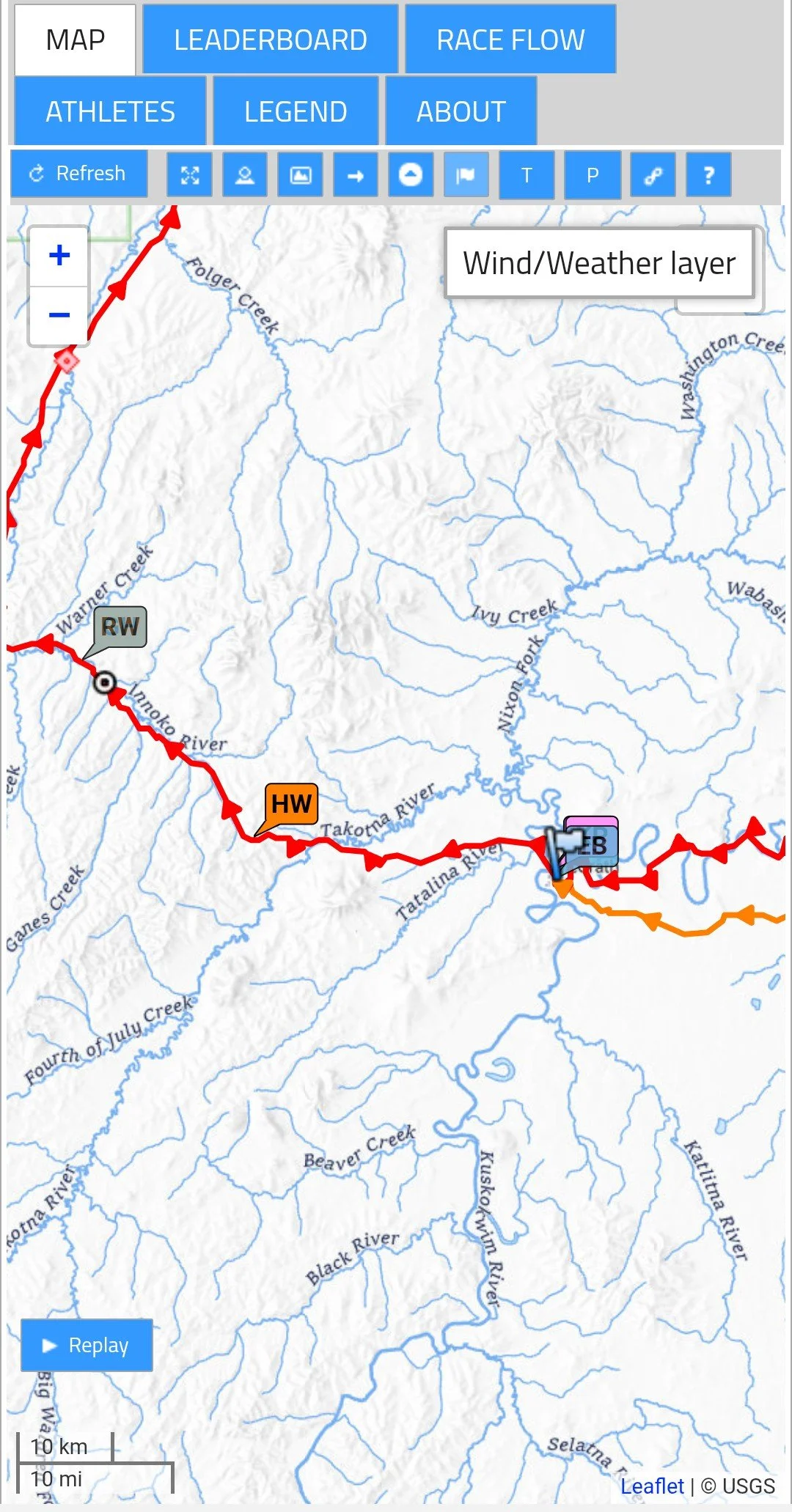
Remaining racer dots on the map between McGrath and Ophir
Today brought peace and quiet on the trail, with seven athletes still bound for Nome…but not moving.
Currently, three racers remain out on the trail while four are still regrouping and recouping in McGrath.
Ryan and Gavan are currently hunkered down together in Ophir, well stocked with supplies and taking a patient approach. Rumor has it Gavan may have even stumbled upon a bit of trail treasure — an abandoned cooler of meat. Herman is some miles behind them, seemingly making his way back to McGrath.
Wild Winter Women, Kendall and Mayella, have been in McGrath since yesterday alongside racers Troy and Erick. The group spent the past 24 hours doing the quiet but essential work that happens between pushes down the trail: making food, repairing gear, and getting ready for the next leg of the journey.
In a race like this, sometimes progress isn’t measured in miles — it’s measured in preparation and patience.
The weather today was one of the mildest our racers have seen so far with a high that reached 10°F, light winds, with a dusting of snow falling. Snow is expected to continue overnight and into tomorrow, with an inch or two possible around McGrath.
With racers waiting, resting, and prepping for their next moves, today felt like a good time to highlight one of the people who helped make this race possible.
The Iditarod Trail Invitational relies heavily on volunteers who brave the same remote conditions as the racers themselves. From hauling supplies to gathering water and running checkpoints for days at a time, their work is essential to the event.
Today we’re featuring a volunteer Q&A with one of our own Wild Winter Women, Faye Norby.
Volunteer Spotlight: Faye Norby
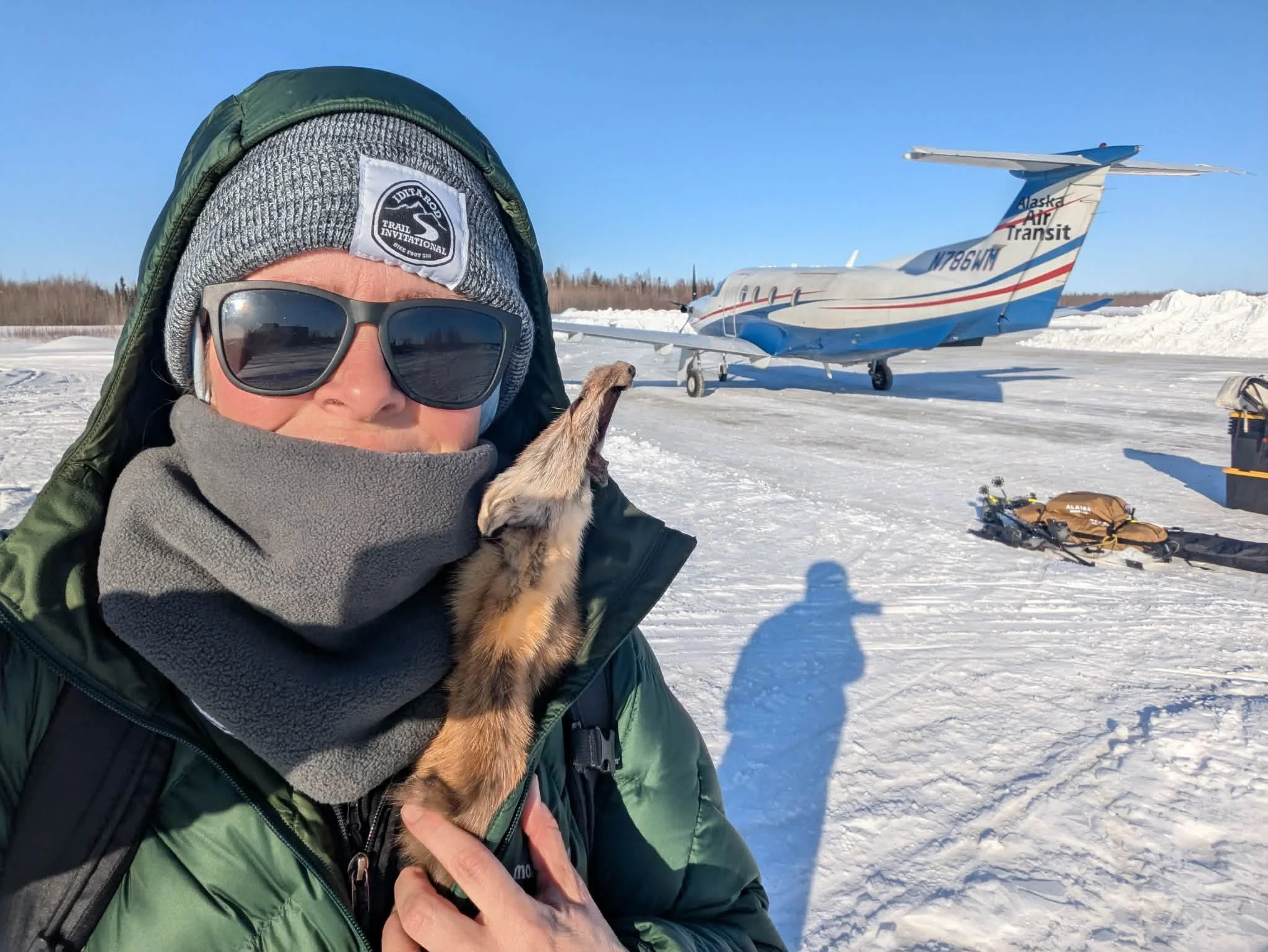
Faye Norby holding a gifted marten pelt from a local
What’s the most impressive thing you’ve seen a racer push through?
There are so many stories of grit and determination. Anytime I see a biker pushing their bike through a big snowstorm or heaving it onto a large snowdrift, I have great admiration. It also makes me glad I am not a biker!
What’s something about the race that people would never guess unless they volunteered?
The logistics for this race are insane. Everything at the checkpoints — Butterfly Lake, Finger Lake, Rohn, Nikolai, and McGrath — has to be brought in by snowmachine or flown to an airstrip and then transported to the checkpoint.
That takes a lot of planning and forethought to make sure you have everything you need. Tents must be set up at Finger Lake and Rohn, and Nikolai presents its own unique challenges. Even water for racers has to be gathered from a source nearby, which can be difficult in winter.
Things break or don’t work properly, and volunteers constantly have to adapt and overcome to keep everything running.
What’s the weirdest or funniest thing you’ve seen happen at a checkpoint?
Most of the best stories involve ripped or worn-out clothing and body parts showing through. I also get a giggle when racers accidentally burn their clothing or water bottles by putting them too close to a stove. Classic mistakes.
This year Tucker burned a hole in his jacket at the Bear Creek cabin and left a trail of feathers wherever he went until we patched it with duct tape. I was also proud of him for filling the bathroom bucket at the school — I could easily follow his route around Nikolai.
What’s the most chaotic or intense moment you’ve seen during the event?
This usually happens outside the checkpoint, but sometimes racers don’t have great stove-operating skills. That can turn into a pretty harrowing experience for everyone nearby.
When racers arrive at a checkpoint, how can you tell who’s mentally strong enough to keep going another 500+ miles?
It’s fascinating to watch racers come in exhausted and see how one person can influence an entire group — either positively or negatively.
There’s the physical side of recovery, but there’s also recovery for your brain and mental state. The strongest racers make sure they rest both their bodies and their minds. They also stay aware enough to avoid getting pulled into drama.
There’s often talk about weather forecasts, other racers’ issues, people turning around or dropping, and unknowns farther up the trail. The most stable racers focus on what’s directly in front of them instead of worrying about things they can’t control.
Conditions can change quickly. What may be a terrible stretch of weather for one racer might be completely different for someone passing through just a few hours later.
What are the toughest conditions volunteers have to deal with?
Most volunteers staff their checkpoints from the first racer to the last. Because they fly or snowmachine in — just like the supplies — they remain there the entire time.
For places like Nikolai, that can mean staying for an entire week. Volunteers often run on very little sleep depending on when racers arrive and depart, and they’re dealing with the same weather and elements as the athletes.
What advice do you have for racers to make the most of the checkpoint and be a good companion to others there?
This is an important one, because ITI is one of the few races where racers sleep and rest inside checkpoints. People are arriving and leaving at all hours.
Even when you arrive exhausted, come in with a plan. The most skilled racers are usually the most efficient at checkpoints.
Bring in the gear you know you’ll need, hang wet items to dry immediately, and keep your gear organized so you’re not searching for things later or leaving items behind.
If electricity is available, plug in electronics to charge. After that, eat, rest, and sleep — but still try to be efficient. It can help to refill water before sleeping and lay out gear for when you wake up so you can get moving quickly.
Earplugs can be helpful. Most importantly, be respectful of others around you. Keep voices down when people are sleeping and try not to take up more space than you need.
————————————————————
Thank you for your support and insight, Faye!
Temperatures are expected to drop again after the snow moves through the region. As racers prepare for their next efforts down the trail, day 13 closes with a sense of patience across the course, with an unbroken trail beyond Ophir.
Sometimes progress in a race like this comes not from pushing through the conditions, but from waiting for the right moment to move.
We’re anxiously anticipating what lies ahead for our brave racers on their journey to Nome!
Soon the trail will be inhabited by a whole new crew as tomorrow marks the ceremonial start of the Iditarod Dog Sled race which begins in downtown Anchorage at 10:00AM Alaska time.
Written by: Rebecca McVay-Brodersen
Thanks to Wild Winter Women - Allison Carolan, Amanda Harvey, Jan Redmond Walker, Kari Gibbons, Leah Gruhn, Laura Wiesmann Hrubes, Lynn K Hall, Madeline Harms, Rashelle Hintz, Rebecca McVay-Brodersen, and Sarah Bergstrom.
With an extra special thank you to Faye Norby.