
Day 14: In The Spotlight
All eyes are trained on just two locations - Gavan Hennigan and Ryan Wanless stayed put today in Ophir, waiting another day for the snow to stop and the wind to go down. As of now, they plan on pushing forward tomorrow. Herman Watson returned to McGrath, where Kendall Park, Mayella Krause, Troy Szczurkowski, and Erick Bassett are located.
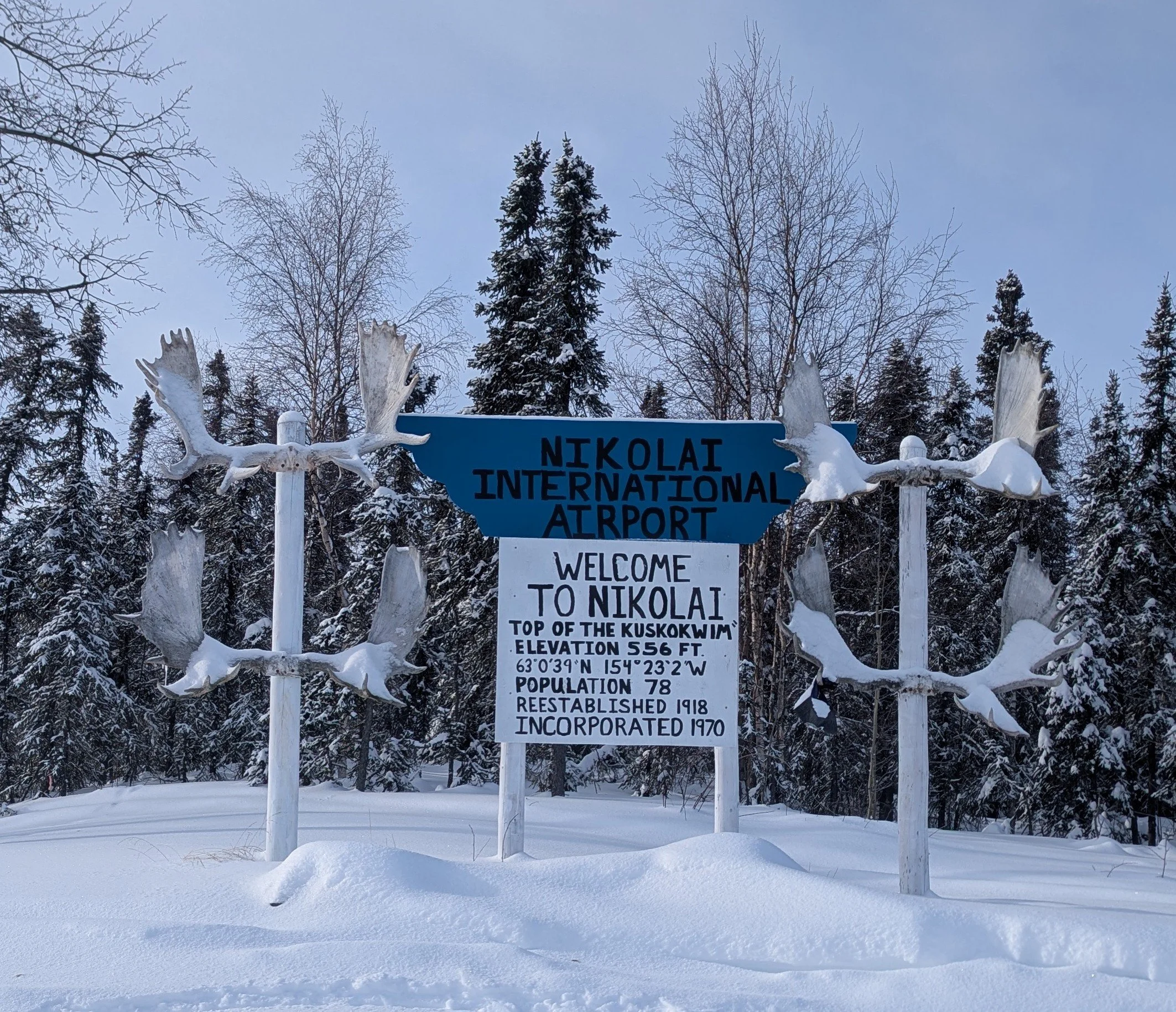
While we await movement from the racers, we would like to take this opportunity to shine the spotlight on the village of Nikolai, AK, where I was fortunate enough to spend a week volunteering for the ITI race. Nikolai is located on the South Fork of the Kuskokwim River, and is roughly 260 miles into the race and 48 miles from McGrath. Nikolai is the only native village our 350-mile racers travel through, and it gives them a glimpse of what it is like to travel through villages during the 1000-mile race.
First up, some background and facts. Nikolai is an Upper Kuskokwim Athabascan village, and although not as commonly used, it also has the Native name of Edzeno (Pronounced ed-ZEE-no). The village has been relocated at least twice since the 1880s, with the present site being established around 1918. It is commonly considered the furthest east the Russians settled in interior Alaska. Nikolai was the site of a trading post and roadhouse during the gold rush, being situated on the Rainy Pass Trail, which connected the Ophir gold mining district to Cook Inlet. It became a winter trail station along the Nenana-McGrath Trail, which was used until 1926. By 1927, the St. Nicholas Russian Orthodox Church had been constructed. In 1948, a school was established, and in 1949, a post office opened. Local residents cleared an airstrip in 1963, which heralded year-round accessibility to the community. The city was incorporated in 1970. The village of Nikolai has a current population of around 85, and its residents are active subsistence food gatherers who also rely on regular plane service to deliver groceries and supplies.
What is it like for our athletes as they arrive at the Nikolai checkpoint? To get here, the racers have traveled about 72 miles from Rohn, usually stopping at Bear Creek Cabin or bivvying outside for a few hours' sleep along the way. They have also crossed Sullivan Creek, which is around 8-9 miles after the cabin turnoff. Here, they can fill up water reservoirs for the push to Nikolai, since Sullivan Creek is always flowing. Racers pass through an amazing stand of birch trees, which is noteworthy for its beauty. About 12 miles before Nikolai, athletes take an abrupt right-hand turn at Fish Camp. There is a small building and some fish-drying racks at this junction, and even though there is a sign that says "Nikolai 10 miles," everyone knows it is more than 10 miles. As they near Nikolai, racers often hear the diesel generator running, supplying the village with electricity. After traveling over small lakes and swampland, racers drop down onto the Kuskokwim River before coming around the bend and arriving at Nikolai. Did you know that on a clear day, you can see Denali and Mount Foraker from Nikolai? When you are coming up the riverbank, be sure to look over your right shoulder to see if they are making an appearance that day.
Nikolai is often the coldest area of the entire race. This year, the lowest reading at the Nikolai airport was -47 degrees F, with most mornings being in the -40 to -45 degree range. It is usually even colder in the low swamps and on the river. This area can also have some amazing northern lights shows.
Racers come up the riverbank and pass between a few houses. The school is a yellow building on the right, and racers head past that to a brown building off to the left, which is the community center. There, they can bring in their sleeping kit and other gear, hang up things to dry on the rope lines, and plug in their electronics. Food choices here this year included a few varieties of burgers, all the oatmeal you could ever want, and a few snack mixes. It is common for racers to arrive in Nikolai very tired, both physically and mentally. On the way out of town, some athletes stop and take a peek at the old Russian Orthodox Church, since the trail goes right past it. It is worth taking a few minutes to stop and look inside.
Village life has its challenges, and this year was no exception. There were no working toilets at the community center, so athletes walked to the school to use its toilets. Those weren't working properly either, so athletes dumped water into them to flush, which sometimes meant hauling a bucket down the hallway from the water fill room. However, this did give athletes a glimpse inside the Top of the Kuskokwim School, which currently has 12 students enrolled across all grades. The community center also lacked running water this year. In Nikolai, residents usually have water piped into their homes, but it is not fit for drinking. Therefore, they either get their drinking water from the clinic, which has a water treatment and filtration system, or they pull water from the river through a hole in the ice. Locals seem to have developed immunity to the various parasites and bacteria in the river water and can drink it without issue. For our racers, the volunteers hauled water from the clinic. Local residents rely heavily on hunting, trapping, and fishing for much of their food source. Plane service usually brings freight, including groceries, a few times a week when the weather is good. The village was also dealing with the recent death of the First Chief of Nikolai, Nick Alexia Sr. Several years ago, Nick sat down with the Tanana Chiefs Conference to share his life story as part of the Legacy of Our Elders series. If you have time today, we encourage you to take a moment to watch his video and learn about his incredible legacy, and get a glimpse of what it was like growing up in this area. https://www.youtube.com/watch?v=b3An7NK7TBI Our thoughts are with the community during this difficult time.
Even amid these challenges, the ITI received a warm welcome from both the community and the school. We received an invitation to attend a community gathering/potluck one evening. Local man of many hats, Phil, fixed the heat in the building, brought us a few supplies and additional heaters, made the water runs to the clinic, and hauled supplies to and from the airstrip, among other deeds. On the last night of the checkpoint, he also brought in moose soup for the volunteers and racers. We all enjoyed this very much. On the same night, resident Stephanie also brought in some beadwork for us to look through, with several people buying her artwork. The race used to stop at Stephanie’s family home, so she knows many of the long-time racers very well. Several volunteers and racers had wonderful interactions with the school principal, Elise, and with two crisis management workers, Bernice and Marie, who were staying at the school for a few days. The ITI is very thankful that we have a warm place to stay and a place for racers to shelter.
Written by: Faye Norby
Thanks to Wild Winter Women - Allison Carolan, Amanda Harvey, Jan Redmond Walker, Kari Gibbons, Leah Gruhn, Laura Wiesmann Hrubes, Lynn K Hall, Madeline Harms, Rashelle Hintz, Rebecca McVay-Brodersen, Sarah Bergstrom