
Day 15: Highway to Heaven or Hell
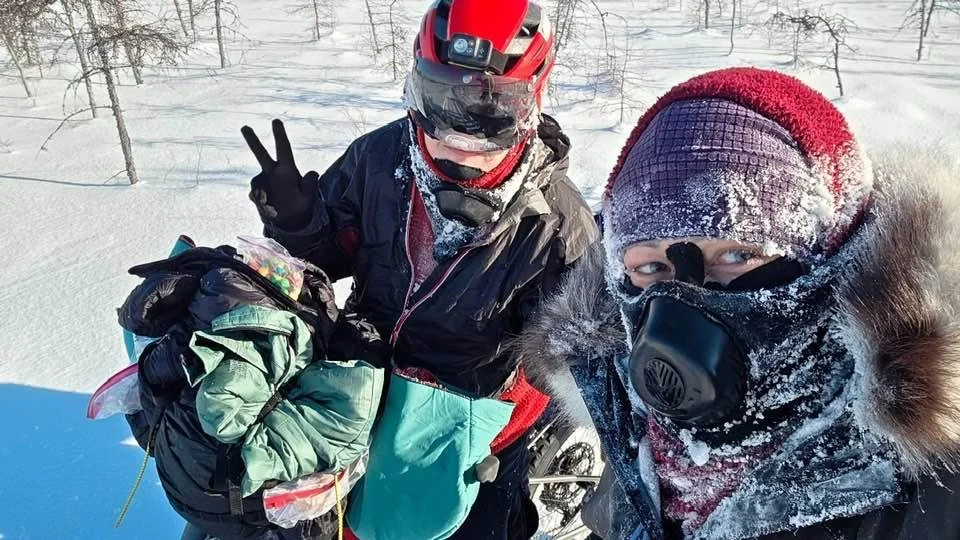
It appears to be a relatively (relatively being the operative word) balmy day for our trail people (and the dog people behind) with a high of 5 degrees and little wind or precipitation. Gavan and Ryan moved out of Ophir, while Kendall, Mayella and Erick likewise staggered out of McGrath late in the day, while they anticipate the Iditarod trail breakers to arrive sometime tonight in McGrath.
The trailbreakers are expected to take on the forty miles to Ophir tomorrow. Gavan and Ryan are likely hoping they will carve the quarter inch crust of ice topping 3-4 feet of snow along the 76-mile trail trajectory to Cripple that follows a meandering Innoko River, breaking north at the confluence of the Innoko and Hunch Creek to cross Tango Creek in a last stretch to Cripple. Following Cripple is a push north through various capillary waterways to join its mighty aorta, the Yukon River, that extends through much of AK.
Troy got an early start out of McGrath, crossing the Kuskokwim and mouth of the Tatalina Rivers before traversing west over a swath of wilderness that include creeks that stem from hills to the south, bleeding into the Tatalina behind and the Takotna ahead. From Takotna he will forage north along Independence Creek and join the Innoko River and its numerous water crossings to Ophir. If he makes it to Nome, he will be the first cyclist to complete the course seven times. His plan, which seems to be working: “My strategy before the race started was to turtle my way up the trail, get to McGrath as late as I could, knowing there was no trail, and be waiting.”
Thus, the waiting place … “The Waiting Place… for people just waiting … waiting around for a Friday night or waiting, perhaps, for their Uncle Jake or a pot to boil, or a Better Break” – (Dr. Seuss “Oh the places they’ll go”) as racers are yet missing a major integer in their race math equations needed to strategize the if and how to reach Nome sweet Nome. So far, Gavan is getting his one ITI wish to beat Herman, who has said sayonara to the trail. It seems that everything from extreme wind, cold and a calendar are working against our little flags, as they hold onto wise judgement in addressing each potential issue that arises.
The Iditarod is certainly living up to its Ice Highway identity, but whether it’s a highway to heaven or a highway to hell might be up for debate depending on who (and more particularly, when) you ask. As racers seek to chase our fearless sky hunter, Orion, up towards the tundra and beyond, we watch, wait and wonder over our own, precious satellites as they problem solve their way a millimeter at a time over the Iditarod constellation, having survived windchills half the way to absolute zero just days before. Some even manage the journey in high fashion. What I wouldn’t give to hear Kendall and Mayella discuss their customized innovations, self-created and field tested: a one stop shop product research and development team. Kendall modeled what appears to be a silicone snorkel-like contraption for breathing cold air at our WWW retreat early last December. Her knowledge base and creative problem-solving skills as a medical student are likely being tapped on such an expedition as this.
Expedition, because the title, “race”, does not fully encompass the gains and losses of this endeavor. What is lost in not finishing may be gained back in spades as survival and the gift of wisdom that only an extreme trek such as this can provide, as trail people learn to rely on cool heads amid the fires of frostbite and hypothermia.
This writer, being a devoted fan of Wild Winter Women, and now the ITI, might just prefer to forgo such wisdom - especially after this year of anxious dot watching, turning on a dime from backseat driver (shouting no! in public places as people look askance), to knuckle biting concern. Why do they do what they do? Why do they flirt with suffering and even death – that ever pregnant reality in winter ultras?
Mayella writes as part of a social media post: “There’s a common misconception about winter ultras. Most people assume we do this because we like suffering. Suffering is simply part of the admission price. What we’re really after are the moments that are bigger than ourselves, the kind you can’t manufacture in ordinary life. A frozen river under the northern lights. The rhythm of tires on snow. The strange clarity that arrives somewhere around day 2, when the mind finally stops arguing, and the body takes over. We know it will be hard. We show up anyway.”
Ryan’s wife, Emily, appears to concur, saying, “It’s about being in places where people don’t normally go.” (quote from an article posted on Ryan’s Facebook)
The quest for family and friends - who may not identify with this - to understand, is all part of that quest to love and support, even in a place of doubt. Athletes, do you know just how much love is poured into your every step as you face the solitude of an untamed land, cocooned in your fragile nylon bivy, swallowed by conditions both beautiful and inhospitable; satellites in space following a constellation that looks an awful lot like a raised whip about to crack?
If there is one common characteristic between the athletes that endure (beside perhaps the explorer gene), it appears to be a determination to overcome, for embracing what is in lieu of pining for what is not. Few have captured this practice in words with more grace and consistency than Carol Seppilu, who writes on Instagram:
“What I’ve learned is that life is beautifully fluid. If you’re in a state of unhappiness it doesn’t always have to be that way. The power of movement changed the course of my life as I took that first step towards running. To have come out of such immense darkness shows that no matter how little faith you think you have, it’s enough. Even the smallest particle of light outshines the dark. The mountains I’ve climbed are much bigger than those in this world and it has taught me to let go of the heavy stuff and overcome them. We aren’t meant to carry mountains; we are meant to climb them. Keep going.”
Written by: Sarah Bergstrom
With a special thank you to Faye Norby.
Thanks to Wild Winter Women - Allison Carolan, Amanda Harvey, Jan Redmond Walker, Kari Gibbons, Leah Gruhn, Laura Wiesmann Hrubes, Jessica Roschlan, Lynn K Hall, Madeline Harms, Rashelle Hintz, Rebecca McVay-Brodersen,